
Audio1x
Speed
Pause
PracticeRead
Mode
Woordenschat
Welcome back to ramble, Dutch for couples.
I'm Rick, and today we are going somewhere that many of you have been dreading.
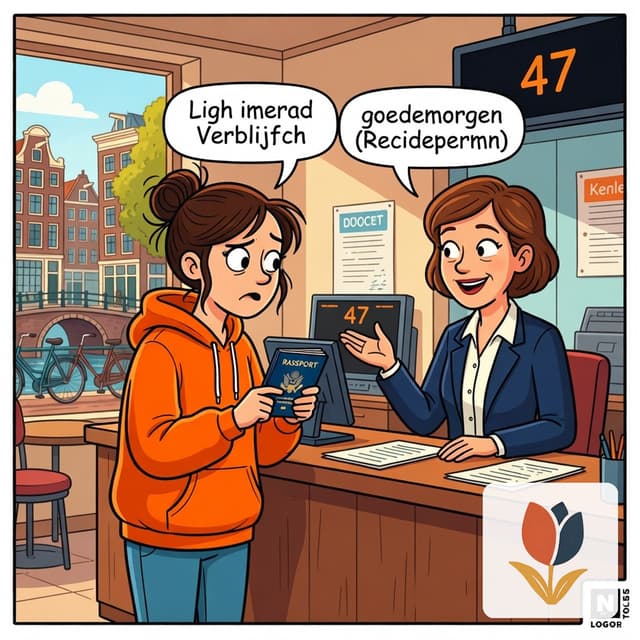
The gemeentehuis. The municipal office.
That particular combination of plastic chairs, a ticket machine,
and a number on a screen that refuses to move.
If you are renewing your verblijfsvergunning, your residence permit,
you already have enough stress.
The paperwork, the deadlines, the fear that you have forgotten something.
The last thing you need is to arrive, open your mouth in Dutch,
and have the person behind the desk immediately switch to English.
But that is exactly what happens to most ex-pat partners.
And today we are going to watch Sarah handle it with grace.
Before we listen, I want you to pay attention to three specific moments.
First, notice how Sarah uses one clear anchor sentence right at the start.
Ik kom mijn verblijfsvergunning verlengen.
She does not apologise, she does not hesitate.
She states her purpose in Dutch before anyone can make assumptions about her.
Second, listen for the moment the ambtenaar switches to English.
Sarah does not panic, she does not give up.
She uses a polite, direct phrase to reclaim the conversation.
Watch how she does it without causing offence.
Third, pay attention to what Sarah asks for at the end.
When you are dealing with anything bureaucratic, always get it in writing.
Sarah has a phrase for that too.
Number 47, that is us.
Let's go in.
Goedemorgen, wat kan ik voor u doen?
Goedemorgen.
Ik kom mijn verblijfsvergunning verlengen.
Of course I can help you with that.
Do you have your passport and your current permit with you?
Ja, die heb ik bij me.
Maar, eh, ik wil graag in het Nederlands oefenen, mag dat?
O. Ja, natuurlijk, hoor. Geen probleem.
Excuus.
Dus, uw paspoort en uw verblijfsvergunning, graag.
Dank u. En uw BSN-nummer, dat heeft u ook bij de hand?
Mijn BSN? Ja, even kijken...
het staat op dit formulier, toch?
Dit nummer hier?
Dat klopt, ja.
Dat is hem. Goed.
En u woont nog steeds op dit adres? Prins Hendrikkade, is dat correct?
Ja, dat is nog steeds hetzelfde adres.
Prima.
Dan heb ik ook nog een uittreksel van de basisregistratie nodig,
of heeft u dat al meegenomen?
Een... sorry,
kunt u dat herhalen? Een uittreksel van...?
Een uittreksel van de basisregistratie personen. Basically, it's a registration extract, it proves your address.
Ja, ik begrijp het, dank u. Ik heb het woord even niet gekend.
Ja, ik heb het hier.
Uitstekend. Nou, alles ziet er goed uit.
De verlenging wordt verwerkt, en u ontvangt bericht binnen, laten we zeggen, zes tot acht weken.
Zes tot acht weken. Oké.
En wat krijg ik nu mee vandaag? Komt er een bevestiging, of...? U krijgt een SMS-bevestiging op het telefoonnummer dat bij ons bekend is.
Hmm, ik wil het graag zeker weten. Kunt u dat op papier zetten alstublieft?
Op papier? Ja. Een bevestiging, met de datum van vandaag en de zes tot acht weken.
Voor mijn eigen administratie.
Nou, we doen dat eigenlijk niet standaard, maar ik kan u wel een ontvangstbewijs printen. Even wachten.
Dat is heel fijn, dank u wel.
Alstublieft. Hierop staat de ontvangstdatum, uw referentienummer, en de verwachte verwerkingstermijn.
Perfect. En als ik nog vragen heb, kan ik dan op dit nummer bellen?
Ja, of via de website. Maar met dit referentienummer kunt u ook online de status volgen, hoor.
Heel goed. Dank u wel voor uw hulp.
Graag gedaan. Nog een fijne dag verder.
U ook.
Well done, Sarah. And well done to you, for listening all the way through that.
Ambtelijke Dutch, the language of Dutch bureaucracy, is genuinely its own register.
The vocabulary is formal. The sentences are long.
And words like "uittreksel uit de basisregistratie personen" are not in any beginner's phrasebook.
So give yourself credit for staying with it.
Let me pull out the three phrases I want you to take away from today.
Takeaway 1. "Ik kom mijn verblijfsvergunning verlengen."
This is your opening move.
Notice it is not a question. It is a statement of purpose.
You arrive, you say what you are there to do, and you say it in Dutch.
That single sentence sets the tone for the entire interaction.
Take away two.
"Ik wil graag in het Nederlands oefenen, mag dat?"
Mag dat.
This is your reclaim phrase.
Warm, polite, completely reasonable.
Most ambtenaren will respect it immediately.
The key word is graag.
It softens everything.
You are not demanding.
You are requesting.
There is a difference.
And Dutch people feel that difference.
Take away three.
Kunt u dat op papier zetten alstublieft?
Always.
Always ask for this.
In any bureaucratic setting, a verbal confirmation is worth nothing if something goes wrong later.
Sarah got her ontvangstbewijs today because she asked.
You can too.
Practice these three phrases before your next visit.
Say them out loud.
Say them to your partner tonight.
They will appreciate the effort I promise.
Tot de volgende keer.
En veel succes bij het loket.
Settings
Text
Mode
Audio
Pause