
Audio1x
Snelheid
Pauze
OefenenLees
Modus
Woordenschat
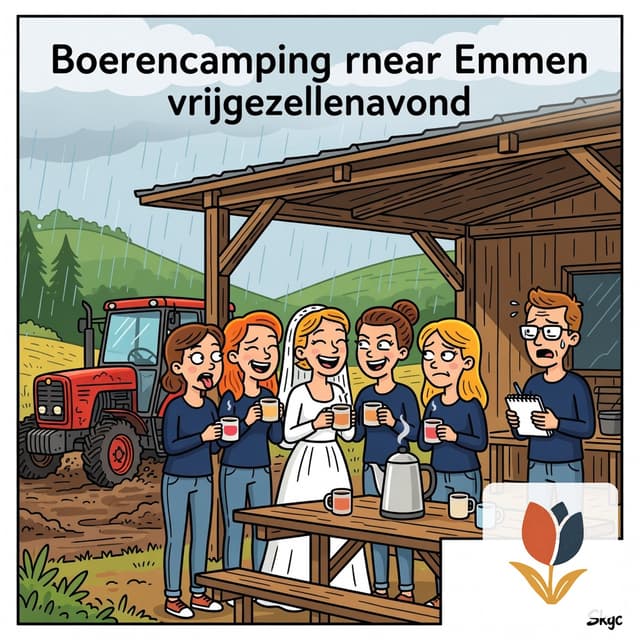
Right, so imagine this. You are standing in a muddy field somewhere outside
Eman. It is raining. Someone is handing you a cup of cold coffee and a tractor is idling
30 meters away. This is the hen-night. This is the vrijgezellenavond, and everyone around you
is laughing at something you did not catch, because they are speaking Drents. Welcome to Episode 40.
Today's scene is Marieke's bachelorette weekend at a boerencamping in Drenthe.
Marieke is Sarah's schoonzus, her partner's sister, and she is getting married in three weeks.
The bruidsmeisjes, the bridesmaids, are all local. They are warm, they are funny. They are
absolutely committed to their dialect, and Sarah is doing her best. Now, Drents is not a thick
regional accent. It is a recognized language variety with its own vocabulary and its own
rhythm. Words shift, sounds soften. Things that look like Dutch suddenly mean something slightly
different, or nothing you recognize at all. This is genuinely hard, even for Dutch learners at a
solid B1 level. But here is the thing I want you to notice. Sarah does not freeze. She does not go
silent and stare at her phone. She uses three very clever moves. Listen for number one, how she laughs
along and says, ik versta er geen woord van maar het klinkt leuk. That phrase does something beautiful.
It admits the truth without apologising for it. Listen for number two, how she uses
wat betekent dat in normaal Nederlands, as a rescue line when she actually needs the meaning.
It is direct, it is charming, and it always gets a laugh. And listen for number three, how she closes
the whole evening with, ik heb me kapot gelachen. That one line does more for belonging than a whole
hour of nodding politely. Right, put on a rain jacket. We are going to Drenthe.
Sarah! Kom, kom, hier zitten, naast mij. Ze zijn zo begonnen met het spel, je hebt nog
niks gemist hoor. Gelukkig. Wat voor spel is het? Dus, elke keer als je liegt, moet je koffie drinken.
Koude koffie. Uit die beker. Koude koffie. Waarom koude koffie? Omdat warme koffie te lekker is,
en dit is een straf. Ze zegt dat jij moet beginnen, als buitenstaander. Wat zei ze precies?
Ik, ehm... ik versta er geen woord van maar het klinkt leuk. Ha! Ja dat snap ik.
Ik zal het even uitleggen. Ze zei eigenlijk, gewoon, dat jij de eer krijgt om eerst te gaan. De
eer. Dat klinkt alsof ik heel erg ga verliezen. Waarschijnlijk wel ja. Goed, jij zegt iets over jezelf,
waar of niet waar, en wij raden. Oké. Ik heb nog nooit op een tractor gezeten. Dat geloven we niet,
want we gaan straks op de tractor. Nee echt, ik zweer het. Nog nooit. Ze gelooft je niet,
Grietje. Ze zegt, iedere vrouw die hier logeert heeft al een keer op een tractor gezeten. Dat is een
soort wet hier. Maar ik heb er echt nog nooit op gezeten. Grietje, ik begrijp het niet helemaal, want ze
zei iets met... wat was het? Zoiets als "op de bölle"? O ja, dat is Drents voor,
zeg maar, bovenop zitten. Op de bok. Snapje? Ah. Wat betekent dat in normaal Nederlands?
Gewoon, op de bestuurdersstoel. Op de bok van de tractor. Ah oké! Dus ze zegt ik heb al op de
bok gezeten? Precies. En ze gelooft er niks van dat je dat niet hebt gedaan. Ik drink de koffie niet. Ik ben
onschuldig. Wacht, wacht. Nu is Grietje aan de beurt. Luister goed, misschien pik je er
wat van op. Ik... ja. Ik heb geen idee. Maar ik lach mee hoor. Ze zei dat ze
een keer met haar man in de schuur heeft geslapen omdat de hond het bed had overgenomen. Dat
begrijp ik volledig. Ik bedoel, niet in het Drents, maar de situatie. Sarah, je doet het echt goed vanavond. Ik doe net alsof ik het versta en ik lach
heel hard. Dat is mijn strategie. Eerlijk gezegd is dat ook de strategie van mijn moeder
bij verjaardagen. Oké. De tractor gaat rijden. Iedereen naar buiten.
In de regen? Het is Drenthe, Sarah. De regen hoort erbij. Oké. Oké. Ik ga mee. En? Hoe was het?
Ik heb me kapot gelachen. Echt. Kapot. Zie je wel. Je bent nu officieel een
Drentse vrouw. Absoluut niet. Maar ik heb me kapot gelachen. Dat telt. Welkom in de
familie, Sarah. That tractor scene. In the rain. At a boerencamping outside Emmen. This is real
life for a lot of ex-pack partners. And I love that Sarah does not try to pretend
her way through it. She uses honesty as a social tool. And it works every time. Let me give
you your three phrases for this week. Number one, ik versta er geen woord van maar het
klinkt leuk. I do not understand a word of it, but it sounds nice. This is so much better
than going silent or looking panicked. It is honest. It is warm. And it actually invites
people to include you. The moment Sarah says it, Maria laughs and bridges the gap. That is
not an accident. Number two, wat betekent dat in normaal Nederlands? Now, this only works if
you ask it with a smile, not with frustration. Asking for normaal Nederlands is a gentle tease.
You are acknowledging the dialect with affection. Dutch people, especially Drents speakers,
will love you for it. Number three, ik heb me kapot gelachen. I laughed myself to pieces.
This is how you close a night. Not het was leuk, or ik had een goede tijd. Those are fine,
but they are polite. Kapot gelachen means you were genuinely taken apart by it. It signals
belonging. It says, this was mine too. One last thought, dialect situations are not a test
of your Dutch. They are an invitation into something more specific and more personal than
standard Dutch will ever get you. The families who speak dialect at home are often the warmest
rooms to be in. You just need a few tools to stay comfortable. And Sarah stayed comfortable
in the rain on a tractor. That is the goal. Tot de volgende keer en lach je maar kapot.
Aanpassen
Tekst
Modus
Audio
Pauze