
Audio1x
Snelheid
Pauze
OefenenLees
Modus
Woordenschat
Right, bikes. If you're living with a Dutch partner, you've already discovered that bikes
are not optional. They're basically a fifth limb here, and when your fiets breaks down,
you can't just bin it and order a new one on Bol. No, you go to the fietsenmaker.
Now, the bike repair shop is one of those Dutch environments where things move fast.
The vocabulary is specific, and there's an expectation that you just know what a derailleur is in Dutch.
Spoiler. It's called a derailleur. But everything else? That's where it gets tricky.
I've had students tell me they stood in a bike shop, pointing at their wheel like a mime artist,
because they couldn't remember the word for spokes. Or they nodded along when the fietsenmaker
said the achterlicht needed replacing. Only to realise later, they'd agreed to fix the rear light
when it was the front brake that was broken. The good news is, you don't need to memorise every
bike part in Dutch. You need three things. The ability to point and say, this bit,
the courage to ask the price before they start work, and a clear confirmation of when you can pick
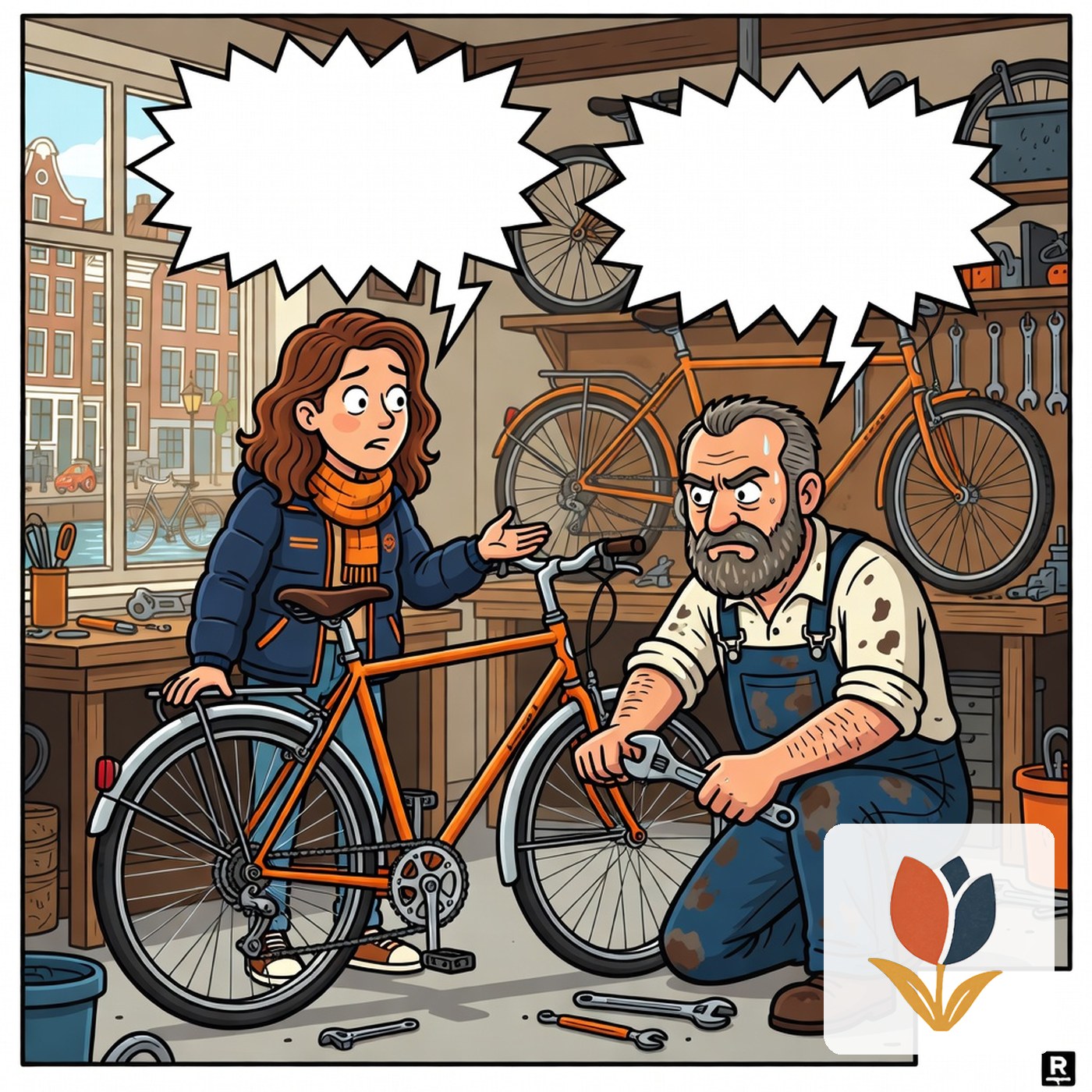
it up. That's it. That's the survival kit. In today's scene, Sarah's bike has a problem. She's not
entirely sure what the problem is, but she knows something's wrong. She's going to take it to the fietsen
maker, and she's going to navigate this with B1 Dutch and a bit of nerve. Here's what to listen for.
One, notice how Sarah uses pointing and gestures when she doesn't know the technical word.
Two, pay attention to how she asks about the cost up front before any work begins. And three,
listen to how she confirms the pickup time, because you do not want to turn up a day early and look
like a keener. Let's go to the bike shop. Hallo, ik heb een probleem met mijn fiets. Ja, wat is er aan de hand?
Eh, deze doet het niet, kunt u ernaar kijken? Welke? De versnelling? Nee, eh... hier. Dit ding. Als ik trap, dan... niks. Oh, de ketting. Ja, die is eraf. Gebeurt vaak.
En je achterwiel zit los, zie je? Dat moet ook. Oh. Oké. Wat gaat dat ongeveer kosten?
Ketting erop zetten is tien euro. Achterwiel vastmaken, vijftien. Maar wacht, je remmen...
die zijn helemaal versleten, joh. Dat is gevaarlijk. Oh nee. Echt? Ja, kijk maar. Helemaal glad. Je
moet nieuwe remblokken. Anders kun je niet stoppen in de regen. Hmm. Hoeveel kost dat? Remblokken voor en achter, dertig euro. Inclusief monteren. Oké... en alles samen?
Vijfenvijftig euro. Zal ik het doen? Ja, doe maar. Wanneer is hij klaar?
Morgen na de lunch. Rond twee uur? Morgen... twee uur. Oké, prima.
Heb je een bonnetje nodig? Ja, graag. Naam? Sarah van der Berg.
Van der Berg... oké. Telefoonnummer?
Eh, nul zes, twee drie... Rustig, rustig. Nul zes? Nul zes, twee drie, vier vijf, zes zeven.
Goed. Morgen twee uur. Neem contant geld mee,
pinnen kan ook, maar contant is sneller. Oké, bedankt!
Ja, tot morgen. There you go. Short, functional, and she got the job done.
That's the beauty of these transactional situations. You don't need to be eloquent.
You need to be clear, and you need to protect yourself from surprises.
Let's pull out the three phrases that are absolute gold in this scenario.
First, when you don't know what's wrong, but you know something's broken.
Deze doet het niet, kunt u ernaar kijken? Literally, this doesn't work.
Can you look at it? Simple, direct, and it hands the diagnosis over to the expert.
You're not claiming to know what a derailleur is. You're just saying,
this bit, it's broken. Please help. Second, before any spanners come out, you ask.
Wat gaat dat ongeveer kosten? What's that going to cost, roughly? This is not rude. This is sensible.
Dutch people ask this all the time. It's how you avoid walking into a fifty euro job when you
thought it'd be a tenner. That word ongeveer, approximately, gives them room to estimate
without pinning them down. Third, once you've agreed to the work, you confirm the pickup time.
Wanneer is hij klaar? When will it be ready? Notice Sarah repeats the time back to him.
Morgen twee uur. That's not being annoying. That's being Dutch. Repetition confirms
understanding, and it saves you a wasted trip. One last thing. If your fietsenmaker starts rattling
off extra repairs, like Sarah's remblokken situation, you're allowed to ask for a moment.
You can say, "Mag ik even nadenken?" Can I think about it for a moment? Then step outside, text your
partner, check your budget, whatever. No one expects you to make financial decisions under pressure,
while standing in a greasy bike shop. Right. That's your bike shop survival kit. Now go forth and get
your fiets fixed. Tot de volgende keer, en vergeet je fietssleutel niet.
OefenenLees
Tekst
Modus
Audio
Pauze