
Audio1x
Snelheid
Pauze
OefenenLees
Modus
Woordenschat
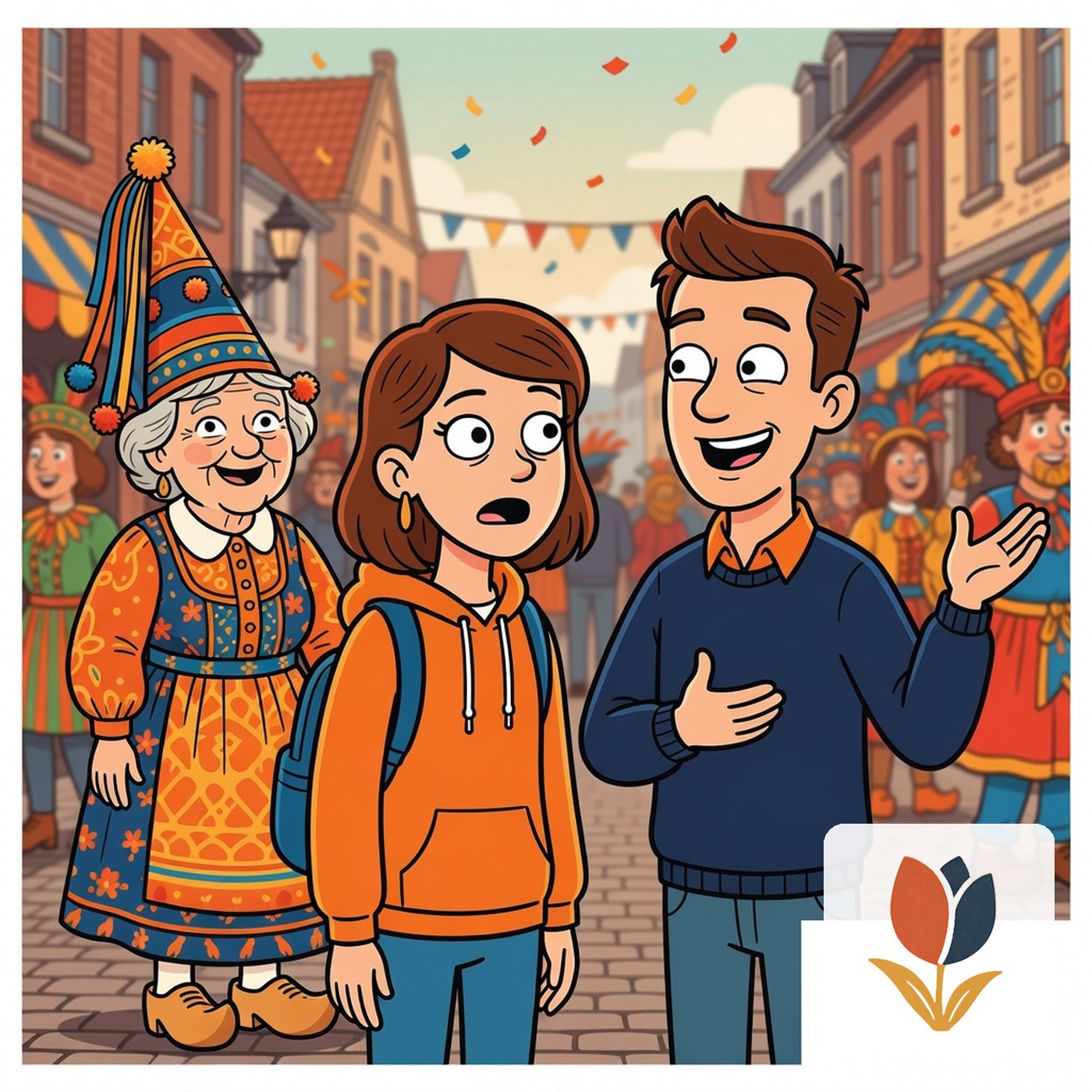
Right. Carnival in Limburg. If you've never experienced it, imagine this.
Brass bans in the street, everyone in costume, beer flowing from 10 in the morning,
and an entire province speaking a dialect that sounds nothing like the Dutch you've been learning
for two years. Sarah's partner Tyse has family in Maastricht. His Oma still lives there,
in the same house where Tyse spent childhood carnivals. And this year, Sarah's going along.
She's prepared herself, she thinks. She's been practicing her Dutch. She can handle a family
gathering, right? Except at Carnival, nobody speaks Dutch. They speak Limburgs. And after the
third round of beer, they speak even more Limburgs. And the music's loud, and everyone's laughing.
And Sarah suddenly feels like she's back at day one, understanding absolutely nothing.
Now here's what I love about this scene. Sarah doesn't freeze up. She doesn't retreat into
English. She doesn't smile politely and pretend to understand. Instead, she does three things that
every ex-pat partner should learn. First, listen for how she laughs. Not a nervous laugh,
but a real one. She finds the humour in her own confusion. That shift changes everything.
Second, notice how she asks what things mean. No embarrassment, no apology,
just straightforward curiosity. Wat betekent dat becomes her favourite phrase of the day.
And third, watch how she sets herself a tiny goal. One dialect word per hour. Not fluency,
not perfect comprehension, just one word. It's brilliant. It keeps her engaged without overwhelming
her. Let's listen in. It's late afternoon. The kitchen's warm. Oma's had a few, Sarah's had a few,
and they're trying to have a conversation.
Zeet geer noe kindsje, dao kump dao carnaval wejer. Ow, ow, ow, wat bin ich blij desse geer dao bis?
Ja, ik ben ook blij, maar oma, sorry, ik verstond dat niet helemaal. Wat zei je?
Dao ich zag, geer bis dao, veur carnaval, dao's toch prachtig. Ja, prachtig.
Maar sorry, oma, spreek je Nederlands, of is dit? Nederlands? Nae nae nae, we kalle heir
Mestreechs. Limburgs, dao's völ sjeuner. Mestreechs. Oké, ik snap het. Een beetje.
Thijs zei dat je altijd Limburgs praat met carnaval.
Altied, altied Mestreechs. Anger ich junk waas. Dao kalde v'r allemaol Mestreechs.
Dao waas gin Hollands. Dao dee v'r neet aan. Oké, oma, ik ben eerlijk.
Ik versta misschien 10 procent. 10, dao's good, dao's völ. Kums dao, drink noen e beierke mit mich.
Een beierke, wat is dat? E beierke, e beerke dao. Oh, een biertje. Beierke betekent
biertje. Joa, bis dao neet sjlim? Sjlim, slim, of slecht. Sjlim, sjlim, dao's good, dao's löstig.
Oké, sjlim is leuk, grappig. Joa, joa, joa, geer leers sjnel.
Ik probeer. Oké, oma, ik heb een plan. Ik leer vandaag Limburgs, leer mij een woord.
Een woord per uur. Dan kan ik het onthouden.
Ei woord, dao kinne v'r doon. Ei woord. Dao woord is sjtofzuger. Sjtofzuger, wat is dat?
Dao is hoe zegke dao. In Nederlands? Ich weit 't neet. Ja, weet het niet in Nederlands.
Oké, is het een ding in het huis? Joa, in 't hoes. In de keuken. Nae, nae, in de kammer. Geer zugs demit.
Zugs, zuigen, een stofzuiger. Sjtofzuger is stofzuiger. Joa, perfekt. Geer bis sjlim. Dank je, oma.
Oké, woord nummer 1, beierke, woord nummer 2, sjlim, woord nummer 3, sjtofzuger. Dit gaat goed.
Dao geit good joa. Noe kalle v'r wie dao echte Limburgers. Alaaf. Alaaf, dat versta ik. Alaaf.
Haha, kumps dao. V'r goon nao boete, de optoch kump zoë. De optoch, de parade, met de wagens.
Joa, joa, mit de preensewage en de muzikante en dao heile sjtuvver. Sjtuvver, dat versta ik niet. Wat betekent dat? Sjtuvver.
Dao heile sjtuvver. Dao heile zootje. Alles, iedereen. Ah, de hele boel, het hele feest.
Joa, joa, joa, joa. Geer bis dao good. Noe kumme, v'r misse dao optoch. Ja, kom maar. En oma, onderweg, nog 1 woord?
Natuurlijk, v'r leere geer dao heile daag. Haha, misschien niet de hele dag, maar een beetje. Alaaf, oma.
Alaaf, kindsje. Alaaf.
Beautiful. Did you catch what just happened there? Sarah walked into a situation where she literally understood
10% of what was being said. Limburg's dialect during Carnival is not beginner-friendly.
It's not even intermediate-friendly, but Sarah turned it into a learning moment instead of a nightmare.
Let me pull out 3 phrases you need to have ready for moments like this. First, dat versta ik niet. Wat betekent dat?
I don't understand that. What does that mean? No shame, no apology. Just a straightforward question.
Sarah used this again and again. She didn't pretend. She didn't nod along. She just asked.
And you know what? Oma loved it. Dutch people, even dialects speaking Limburg's at Oma's
appreciate directness. Second, ik leer vandaag Limburgs. Leer mij een woord. I'm learning Limburgs
today. Teach me a word. This is such a clever move. Sarah turned the conversation into a game. One word
per hour. It gave her something concrete to focus on, and it made Oma feel like a teacher.
Everyone wins. And third, alaaf. This one's just for Carnival. It's the Limburg Carnival greeting.
It means nothing specific. It just means you're part of the party. If you're ever at Carnival in Limburg,
Brabant, or anywhere south, just shout alaaf. And you're in. People will love you for it. The bigger
lesson here, sometimes the goal isn't understanding everything. Sometimes it's about staying curious,
staying engaged, and laughing at the chaos. Sarah's Dutch isn't perfect, but her attitude is.
And that's what keeps her in the conversation. Alaaf, mensen.
OefenenLees
Tekst
Modus
Audio
Pauze