
Audio1x
Speed
Pause
PracticeRead
Mode
Woordenschat
Right. Today we're putting you in a situation that nobody wants to be in.
You are alone in the car, somewhere on a Dutch motorway, and something goes wrong.
The engine light comes on. Red. Not amber. Red.
And suddenly, you have to make a phone call in Dutch in a noisy environment
to a stranger who is going to ask you questions fast and not slow down unless you ask him to.
This episode is about exactly that.
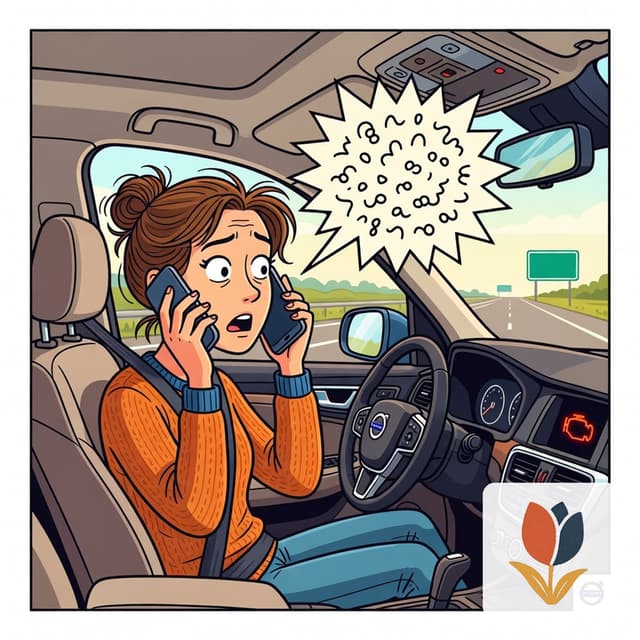
Sarah is on the A2 near Den Bosch when the Volvo decides it has had enough.
She pulls over on the hard shoulder, trucks thundering past, and she calls the ANWB.
That is the Dutch roadside assistance service.
Think the AA in the UK or the ADAC in Germany.
They are professional, they are helpful, but the first two minutes of that call are a genuine Dutch language test.
Now, before you listen to the scene, I want to give you three things to listen for.
First, listen to how Sarah opens the call.
She does not say, hello, and then wait.
She immediately puts her situation on the table with one clean sentence.
That sentence does all the context-setting work instantly.
Second, listen to how she handles the location question.
On Dutch motorways, the green posts at the side of the road have numbers on them.
Those are the kilometerpalen.
Sarah uses that number as a sentence anchor.
She builds her location answer around it, so even if everything else wobbles,
Frank knows exactly where she is.
Third, listen to what Sarah does when Frank speaks too fast.
She does not apologise three times and switch to English.
She uses one short polite direct question.
That is it, one question.
Watch for that moment because it is the most transferable skill in this whole episode.
Oké, oké. Rustig. Bellen. ANWB.
Welkom bij de ANWB Wegenwacht.
Voor pechhulp op de weg, toets één.
Voor lidmaatschap, toets twee.
Voor...
Één. Één, één.
ANWB Wegenwacht, u spreekt met Frank, goedemiddag.
Goedemiddag.
Ik heb pech op de snelweg.
De A2, richting Den Bosch.
Oké, goed dat u belt.
Mag ik uw lidmaatschapsnummer?
Ja, één moment...
het is, eh... nul-nul-drie-zeven-vier-twee-acht-negen.
Dank u.
En uw naam?
Sarah Vermeer.
Mevrouw Vermeer,
kunt u mij vertellen wat er precies aan de hand is met het voertuig?
Ja. De motorlamp is rood geworden.
Rood, niet oranje.
En, eh, ik hoor een beetje een raar geluid, een soort... tik-tik-tik?
Oké. Is de motor nu nog aan of heeft u hem uitgezet?
Ik heb hem uitgezet.
Dat is toch beter?
Ja, dat is goed gedaan.
En waar staat u precies?
Heeft u een hectometerpaal in de buurt?
Een... sorry, een hecto...?
Een kilometerpaal.
Een groen paaltje langs de weg met een nummer.
Oh! Ja, ik zie het.
Ik sta bij kilometerpaal honderd vier.
Honderd vier, A2 richting Den Bosch.
Prima.
Staat u op de vluchtstrook?
De vlucht...
ja, ja.
Ik sta aan de kant.
Rechts.
Goed.
Nu ga ik u een paar vragen stellen over de situatie voor de veiligheidscheck.
Bent u alleen in het voertuig,
zijn er kinderen bij,
zijn alle inzittenden veilig,
zijn de deuren...
Sorry, sorry.
Kunt u langzaam praten alstublieft?
O, natuurlijk. Sorry hoor.
Bent u alleen?
Ja, ik ben alleen.
Zijn alle portieren dicht?
Ja, dicht.
Staat u achter het stuur of buiten het voertuig?
In de auto.
Ik ben...
ik heb de gordel nog om, eigenlijk.
Prima, dat mag u afdoen hoor.
Maar blijf in de auto als het kan, vanwege het verkeer.
Heeft u uw gevarendriehoek al neergezet?
De... nee. Die heb ik niet.
Is dat erg?
Niet ideaal, maar als u in de auto blijft is het oké.
De monteur is over ongeveer veertig minuten bij u.
U krijgt zo een sms met de verwachte aankomsttijd.
Veertig minuten.
Oké.
En... mag ik nog één ding vragen?
Ja hoor.
Thijs, mijn man,
hij is in Utrecht.
Moet ik hem nu bellen of...?
Dat is aan u.
Maar vertel hem wel waar u staat.
Dat is altijd goed.
Ja. Ja, dat doe ik.
Dank u wel, Frank.
Geen probleem hoor.
De monteur heet Edwin.
Succes, mevrouw Vermeer.
Dank u.
Dag.
Oké, Thijs.
Nu bellen.
And for a moment, she almost let Frank run away with the conversation.
But she did not fall apart.
Three things kept her on track.
Take away one.
The very first sentence.
Ik heb pech op de snelweg.
Write that down.
Learn it by heart.
When you ring the ANWB or the garage
or anyone about a car problem,
that sentence is your opening move.
It tells the person on the other end exactly what kind of call this is
before they have to ask a single question.
Pech. Snelweg.
Two words that do enormous work.
Take away two.
The location anchor.
Ik sta bij kilometerpaal honderd vier.
That structure, ik sta bij, plus the landmark, plus the number
is transferable to almost any situation.
Ik sta bij het station.
Ik sta bij de Albert Heijn op de hoek.
Learn the pattern.
On the motorway, the kilometerpaal is your best friend.
Because it is precise, it is visible, and Frank will know it instantly.
Take away three.
The one that I am most proud of, honestly.
Kunt u langzaam praten alstublieft?
No, sorry, sorry, sorry.
No switching to English.
Just one clean request.
Frank stopped immediately and adjusted.
That is what happens when you ask clearly.
People respect a direct, polite question far more than a flustered apology.
One small note.
Frank used the word vluchtstrook.
That is the hard shoulder.
And gevarendriehoek is the warning triangle.
Both worth keeping somewhere in your phone.
Just in case.
Tot de volgende keer en rijd voorzichtig.
Settings
Text
Mode
Audio
Pause