
Audio1x
Speed
Pause
PracticeRead
Mode
Woordenschat
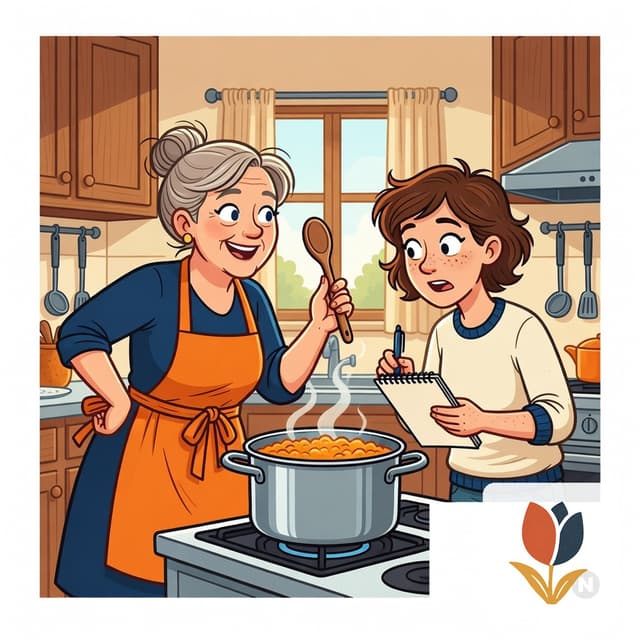
Right. Saturday afternoon. Your partner's mother has invited you to cook together.
Just the two of you. Thijs has conveniently disappeared to the hardware store.
This is one of those moments where you cannot hide behind your partner.
There is no escape route. It is just you, her, and a pot of hutspot that needs constant attention.
Here is what makes cooking together so tricky. The silences.
When you are chopping vegetables side by side, there are these little gaps where nobody is talking.
And that is exactly when your brain starts screaming.
Switch to English. She will understand. Make it easier. But if you do that now, you set a pattern.
Every future Saturday becomes English Saturday and your Dutch stays stuck at restaurant level.
I have seen this happen dozens of times. The expat partner gets nervous.
The Dutch mother-in-law wants to be helpful. Someone switches. And suddenly five years go by and
you still cannot have a proper conversation at family birthdays. So today we are listening to Sarah
cook hutspot with Thijs' mother. Small kitchen. Fast instructions. Dialect words thrown in to
test her. This is the deep end. Three things to listen for. First, notice how Sarah repeats back
what she heard instead of just saying, Huh? Or what? This is a brilliant technique. It shows you
are trying and it gives the other person a chance to confirm or correct without feeling like a teacher.
Second, listen for how Sarah offers help using "Zal ik". She does not wait to be told what to do.
She anticipates. This is how you show you are present in the conversation, not just translating in
your head. Third, and this is my favourite. Notice how schoonmoeder drops in dialect words. Not to be cruel
but to see what Sarah does and Sarah laughs it off. She admits she does not know. This is confidence.
Real confidence is not knowing everything. It is being comfortable with not knowing. Let's listen.
Zo, Sarah, heb je wel eens hutspot gemaakt? Nee, nog nooit. Thijs zegt altijd dat het zijn favoriet is.
Ja, dat klopt. Als kind at hij drie borden, hoor.
Goed, we beginnen met de aardappelen. Die moeten geschild worden. Kun je dat?
Ja, ik denk het wel. Zal ik deze schillen? Perfect. En ik doe de wortelen en uien. We moeten alles in grote stukken snijden, niet te klein.
Anders wordt het pap. In grote stukken, oké. Dus... zo groot?
Ja, prima. Je doet het goed, hoor. Thijs zegt dat je al aardig Nederlands spreekt.
Ah, dat is lief. Maar het is nog steeds moeilijk. Vooral met koken, er zijn zoveel woorden die ik niet ken.
Nou, dan leer je ze vandaag. Kijk, dit is de stamper. Daarmee gaan we straks alles prakken.
Stamper... en prakken. Oké. Hoe noem je dit in het Nederlands?
Dat is een vergiet. Voor het afgieten. Vergiet. Vergiet.
Zal ik de aardappelen in de pan doen? Ja, doe maar. En dan water erbij tot ze net onder staan.
Niet te veel, anders duurt het eeuwen. Eeuwen... Lang, heel lang.
Zeg, Sarah, doe jij ook zout in het water?
Eh... moet dat? Ja, anders smaakt het nergens naar. Hier, een flinke scheut.
Scheut... dat is een klein beetje?
Okay, I understand. A little bit, but not too much.
Precies! Je bent een snelle leerling. Nu moeten we wachten tot het kookt. Wil je koffie?
Ja, graag. Zal ik het zetten?
Nee joh, ga zitten. Jij bent de gast. Vertel eens, hoe gaat het met je werk?
Goed, druk. Maar mijn collega's zijn aardig.
Soms praten ze te snel en dan... dan weet ik niet wat ze zeggen.
Dat is normaal, hoor. Ook voor mij is het soms moeilijk.
Thijs praat met zijn vrienden en dan denk ik, jeetje, wat zeggen ze nou?
Echt? Maar jij bent Nederlands.
Ja, maar ik kom oorspronkelijk uit Brabant. En hier in het westen praten ze anders.
Andere woorden, andere... hoe zeg je dat... uitdrukkingen.
Oh, zoals dialect?
Precies. Zeg, ken jij het woord "aanrecht"?
Aanrecht... nee, wat is dat?
Dat. Waar we nu de groenten op snijden.
Ah! The counter, the... het werkblad?
Ja, werkblad klopt ook. Maar wij zeggen altijd aanrecht.
Kijk, het water kookt. Zal ik de wortelen erbij doen?
Ja, en de uien ook?
Nog even wachten met de uien. Die gaan er over vijf minuten in.
Anders worden ze te zacht.
Weet je, mijn moeder maakte dit altijd met rookworst.
Dat is echt traditioneel.
Rookworst... dat heb ik nog nooit gegeten,
wat zit erin?
Gewoon vlees, gerookt.
Het geeft een hele lekkere smaak.
Maar tegenwoordig maken veel mensen het ook zonder. Vegetarisch, zeg maar.
Ik eet wel vlees. Ik wil het graag proberen, de traditionele manier.
Mooi!
Dan snijden we straks de worst in plakjes en leggen we het erbovenop.
Nu de uien erbij.
Voorzichtig, het is heet.
Zal ik roeren?
Nee, laat maar even.
Het moet gewoon zachtjes koken. We moeten nog twintig minuten wachten.
Vertel eens, wanneer gaan jullie nou eens trouwen?
Oh... we hebben nog geen plannen.
No?
The time is 40 and you are not 20 anymore.
No, I am 36.
But we haven't had anything else.
Well, maybe you have to start over.
I want to see a little girl before I die.
Yes, maybe.
Grab your.
You have to do what you want.
But well, look, the almonds are ready.
Give me one for Giet.
Here, will I eat the water?
No, too dangerous.
I do it well.
You keep the pan fast.
Keep the heat fast, huh?
Yes, I have.
Nice.
And now we are going to crack.
With the stamper.
Look, you do it like this.
With power from above to below.
Do you want to try?
Yes, that's right.
Yes, good.
Harder, but good.
It has to be very nice.
It is heavy work.
Yes, because we have always had the men to crack.
But now we do it ourselves.
A little more milk and butter.
Now the room will be.
It smells good.
But here, on a label.
What do you think?
Good.
But what else do I think?
Good.
How do you like it?
I don't know.
It's simpler, maybe.
But good.
Good, yes.
That's the good word.
The spot is no fancier.
It's just.
Good.
As it is.
Do you think it's good?
Of course.
He thinks everything is good if you do it.
Come, we make the table clear.
He comes home.
So, she's survived.
And more than that, she did three things that really matter.
First, she used zal ik doen to offer help.
Not, can I help in English?
Not waiting to be told.
She said, zal ik de aardappelen in de pan doen?
Zal ik roeren?
This is how you participate.
This is how you show you are not a guest in your own life.
The phrase is simple.
Zal ik, plus a verb, plus doen if you need it.
Shall I do the potatoes?
Shall I stir?
Master this, and you will never stand around uselessly
in a Dutch kitchen again.
Second, she asked,
Hoe noem je dit in het Nederlands?
When she did not know the word for colander.
She did not point and grunt.
She did not switch to English.
She asked the question in Dutch.
This is the key.
You build your vocabulary by asking about your vocabulary.
And you do it in the language you are trying to learn.
Write this one down.
Hoe noem je dit in het Nederlands?
You will use it every single week.
Third, when the topic of rookworst came up,
she said,
Dat heb ik nog nooit gegeten?
Wat zit erin?
She admitted she had never eaten it
and she asked what was in it.
No shame, no pretending.
Just honest curiosity.
This is how you learn food vocabulary.
This is how you learn culture.
You ask and you ask in Dutch.
The uncomfortable moment about marriage and babies.
That is real life.
That is what happens when you cook with Dutch mothers.
You do not have to have the perfect answer.
You just have to not run away.
Sarah laughed.
She deflected gently.
She stayed in Dutch.
That is the win.
Vergeet niet.
De keuken is waar je echt Nederlands leert.
Settings
Text
Mode
Audio
Pause