
Audio1x
Snelheid
Pauze
OefenenLees
Modus
Woordenschat
Hello, and welcome back to Rambl, Dutch for Couples.
I'm Rick, and this is episode 22.
Today we're talking about something that feels small but somehow enormous,
writing your first Dutch Christmas cards.
Not just reading them, not just signing your name at the bottom,
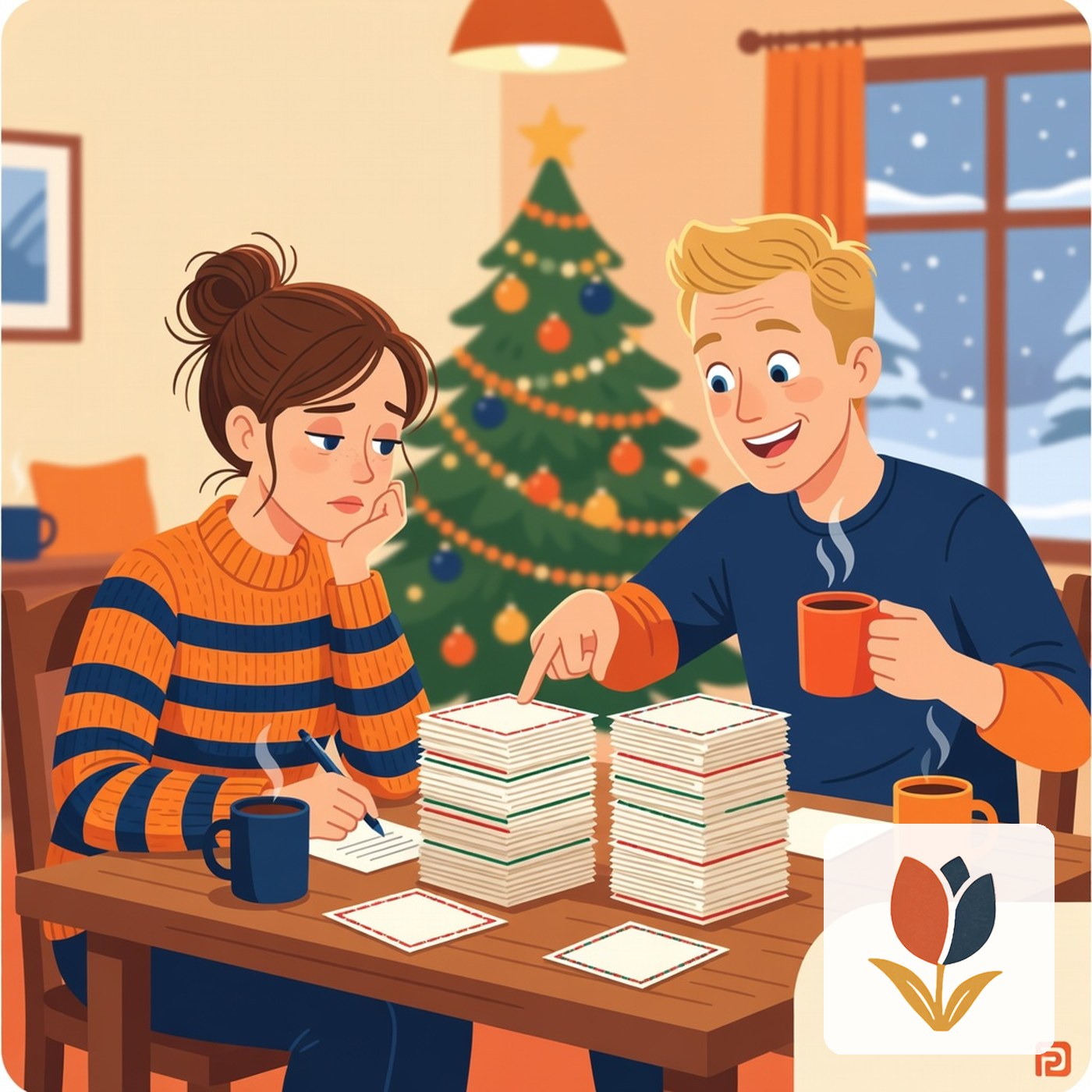
actually writing them as part of the couple, in Dutch, 30 of them.
And here's the thing, speaking Dutch, you can stumble, you can laugh it off,
you can say "sorry, wat bedoel ik ook alweer?" and move on.
But writing Dutch, it sits there on the page, it goes in the post.
Thijs's tante in Friesland will read it three times.
it feels permanent, and that makes people freeze.
Sarah's about to write cards to family, to Thijs's colleagues,
to neighbours she's met twice.
She knows she can't write a novel on each one.
She doesn't need to, but she does need to sound like herself,
like part of the household, not like a Google Translate accident.
So in the dialogue, I want you to listen for three things.
First, notice how Sarah uses short, formulaic phrases,
instead of trying to craft long, personal messages.
That's not lazy, that's smart.
Second, listen for how she signs the cards as part of the couple,
not hiding behind Thijs's name.
And third, notice how she asks Thijs to check her spelling,
not to rewrite everything.
She's keeping ownership of her own words.
Right, let's listen in.
Oké. Dertig kaarten. Dertig.
We doen het samen, hoor. Jij schrijft er vijftien, ik doe vijftien.
Nee, ik wil... ik wil ze allemaal schrijven. Maar jij moet... je moet helpen.
Even kijken of het goed is.
Allemaal? Echt?
Ja. Ik woon hier ook, toch?
Ik ben ook... ik ben ook Sarah van dit huis. Van ons huis.
Oké. Ja. Natuurlijk. Maar je hoeft niet...
je hoeft geen lange verhalen te schrijven, hoor.
Nee, nee. Kort. Gewoon... gewoon een paar zinnen. Maar wel... van mij.
Top. Oké, wie is de eerste?
Je oma. Natuurlijk.
Haha, natuurlijk. Zij leest het drie keer en belt mijn moeder om het te bespreken.
Oh god.
Grapje. Soort van.
Wat wil je schrijven?
Uhm... "Lieve oma..."
Goed. Ga door.
"Fijne kerstdagen en een... een gezond... twee-nul-twee-zeven?"
Tweeduizend zevenentwintig. Maar je mag gewoon 2027 schrijven, hoor. Niemand schrijft het voluit.
Ah, oké. Fijn.
Uhm... en dan... "We denken aan jou." Is dat goed?
Perfect. Echt. Dat is lief.
En dan... "Liefs, Sarah en Thijs."
Mooi. Zie je? Je eerste kaart. Klaar.
Wacht, mag jij even kijken of dit klopt?
De spelling?
Ja, tuurlijk. Laat zien.
Ja... ja, dit is helemaal goed.
Alleen, je hebt "keerstdagen" met twee e's geschreven.
Oh, shit.
Nee, nee, rustig.
Gewoon doorstrepen en opnieuw, of je pakt een nieuwe kaart.
Wij hebben er genoeg.
Nieuwe kaart.
Ik wil niet... ik wil niet dat ze denkt ik ben slordig.
Oké. Nieuwe kaart.
Hier.
Dank je.
Oké. Volgende?
Uhm... mijn collega Maarten en zijn vrouw.
Ik ken hen bijna niet.
Precies. Dus gewoon standaard. "Fijne kerstdagen, tot volgend jaar, groetjes."
Mag ik schrijven... "Fijne feestdagen"?
Is dat ook goed?
Ja, zeker.
Dat is zelfs beter als je het niet zeker weet of iemand Kerstmis viert.
Oké. Uhm... "Fijne feestdagen en een mooi nieuw jaar."
Klinkt goed.
"Groeten, Sarah en Thijs." Of "Groetjes"?
Beiden prima.
Groetjes is ietsje informeler. Jij kiest.
Groetjes. Ja.
Oké, volgende.
Ja, dat klopt.
Dus misschien iets persoonlijkers?
Ja. Uhm... Lieve Ingrid, bedankt voor de lekkere soep.
Fijne kerstdagen. Liefs...
Ja, perfect.
Of, als je het iets korter wilt: Dank voor de lekkere soep in november.
Dan weet ze precies wat je bedoelt.
Ja, goed idee. Dank je.
Mag jij straks alles even checken?
Niet alles herschrijven. Gewoon... fouten.
Ja, tuurlijk.
Ik markeer alleen de spelfouten.
De woorden zijn van jou.
Dank je.
Hoe voel je je nu?
Uhm... gestrest.
Maar ook... een beetje trots?
Ik schrijf Nederlandse kerstkaarten.
Je schrijft Nederlandse kerstkaarten.
Echt waar.
En ze zijn mooi.
Kom, we doen er nog vijf en dan nemen we pauze.
Ja. Oké.
Wie is volgende?
Mijn tante Lies.
Diegene die altijd vraagt wanneer we kinderen krijgen?
Ja, die.
Oké. Uhm... Fijne kerstdagen,
hopelijk tot snel...
Haha, subtiel.
Te subtiel?
Nee, precies goed.
Kom, schrijf maar op.
Right, so what just happened there?
Sarah wrote her first stack of Dutch Christmas cards.
Not perfect cards.
Not literature.
But real, recognizable, personal cards.
In her own Dutch.
With Thijs checking the spelling.
Not taking over.
Three things to take away.
First, the formula that gets you through almost any Dutch card.
Fijne kerstdagen en een gezond 2027.
Happy Christmas and a healthy new year.
You can swap kerstdagen for feestdagen
if you're not sure of someone's background.
You can swap gezond for mooi or fijn.
But that structure, that's your backbone.
Write it down.
Use it.
Second, the signing.
Liefs, Sarah en Thijs.
Or Groetjes.
Or Warme groeten.
But notice, her name comes first now sometimes.
She's not hiding behind his signature.
She's writing as part of the couple.
That matters.
That's what integration actually looks like in tiny ink strokes.
And third, the question she asked when she needed help.
Mag jij even kijken of dit klopt?
Can you just check if this is correct?
Not, can you write it for me?
Not, is this embarrassing?
Just a practical request for a spelling check.
That's the difference between asking for help
and handing over control.
Keep that boundary clear.
Writing Dutch feels permanent because it is.
But that's also why it counts.
Thirty families are going to open those cards
and see that Sarah is becoming part of the household,
part of the language, part of the pattern.
One short message at a time.
Fijne feestdagen.
En tot de volgende aflevering.
OefenenLees
Tekst
Modus
Audio
Pauze