
Audio1x
Snelheid
Pauze
OefenenLees
Modus
Woordenschat
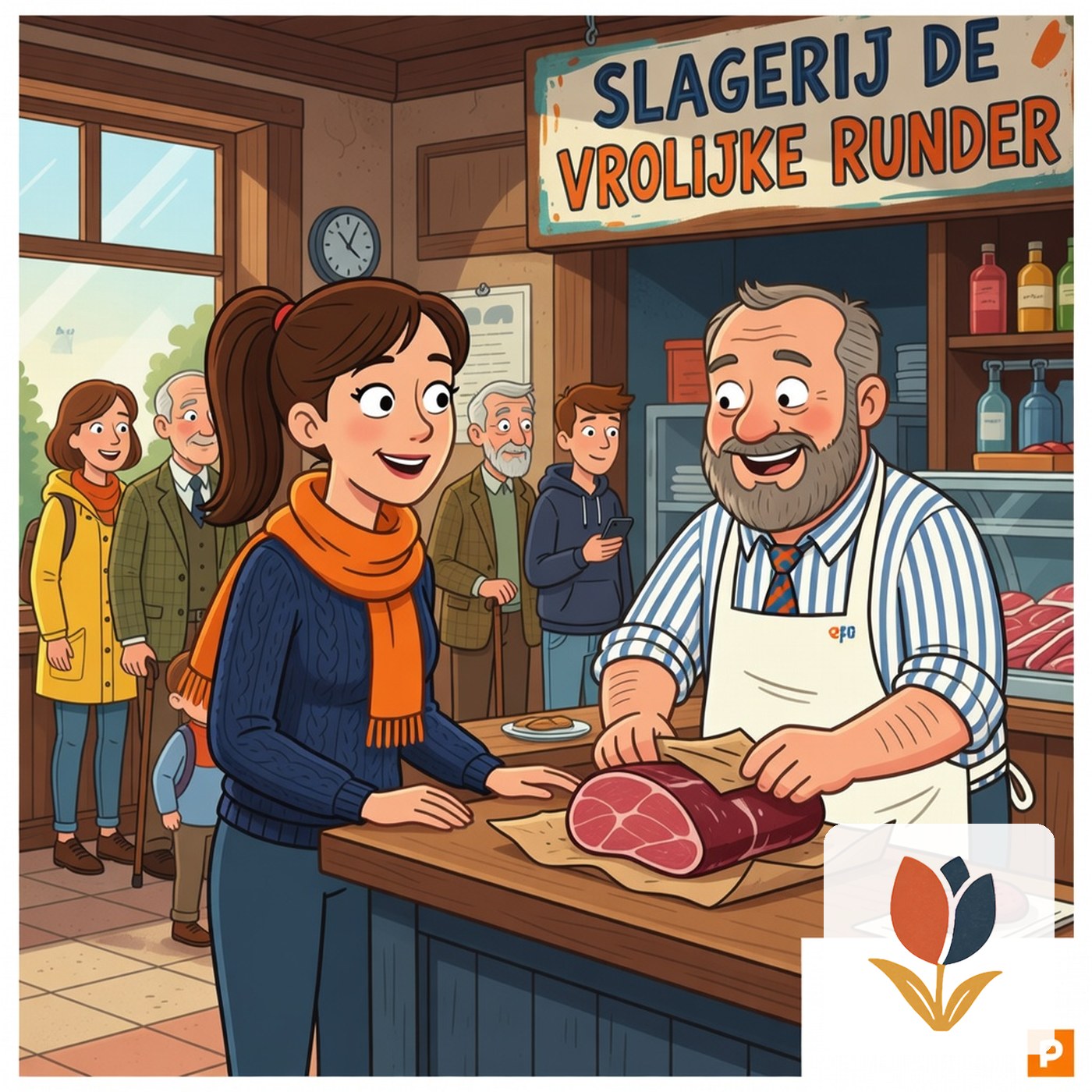
Right, today we're sending Sarah somewhere that makes a lot of ex-pat partners quietly panic.
The Saturday morning slager, the butcher shop, where there's a queue, everyone knows what they want,
and the slager moves fast because he's got 12 people behind you.
Thijs asked Sarah to pick up ossenhaas for their anniversary dinner.
That's beef tenderloin, lovely cut, bit pricey, but it's a special occasion.
The thing is, Dutch butcher shops aren't like supermarkets.
You don't browse, you don't take your time, you step up, you order, you pay, you leave.
The social contract is efficiency, and if you're not used to ordering by weight,
or if you freeze when the slager repeats back the wrong thing,
it feels like everyone's staring at you. Spoiler, they are. But not unkindly, they're just waiting.
So here's what I want you to listen for in today's scene. First, how Sarah orders by weight
using ons, which is a hundred grams. It's still the standard unit in Dutch butcher shops,
and at the kaas counter. Second, watch how she corrects the slager when he misunderstands her.
She doesn't start the whole sentence over. She just corrects the one word. That's key.
Third, listen to how she handles 'anders nog iets?', which is the ritual closing question.
Do you need anything else? Your answer ends the transaction. Let's listen.
Zo. Ik heb hier drieënhalve ons, is dat goed?
Ja, dat is goed.
Mooi zo. Anders nog iets?
Eh... ja. Ik wil ook... gehakt.
Rundergehakt of half-om-half?
Half... half-om-half.
Half-om-half, hoeveel?
Vijf ons.
Vijf ons half-om-half.
Goed.
Zo, dat was vijf ons rundergehakt.
Sorry, ik bedoelde half-om-half, geen rundergehakt.
Oh! Half-om-half, ja, dat zei je.
Foutje van mij, momentje.
Alsjeblieft, vijf ons half-om-half.
Nog meer?
Nee dank u, dat was het.
Mooi. Dan is het bij elkaar...
zestien euro vijftig, alstublieft.
Alstublieft.
Dank je wel. Fijn weekend!
U ook, tot ziens.
There we are. Quick, transactional, no drama.
That's shop Dutch, and Sarah handled it beautifully.
Let's pull out three phrases you should memorize because you'll use them constantly.
First: Doet u mij drie ons ossenhaas.
Doet u mij means give me in a polite transactional way.
Three ons, that's 300 grams.
You can swap ossenhaas for kaas, ham, salami, whatever.
This structure works everywhere.
At the butcher, the cheese counter, the deli.
Doet u mij. Second.
Sorry, ik bedoelde half-om-half.
Sorry, I meant half-om-half, not rundergehakt.
When someone repeats back the wrong thing, don't restart your whole order.
Just correct the one word.
Ik bedoelde X, geen Y.
I meant x, not y.
Clean, efficient.
No apology spiral.
Third.
Nee dank u, dat was het.
No, thank you, that was it.
This is how you close the transaction.
Anders nog iets?
Nee dank u, dat was het.
It signals you're done.
The slager can move on.
The queue can breathe.
One last thing.
Notice Sarah didn't ask for help or explain why she needed ossenhaas.
She just ordered.
That's the unspoken rule in transactional dutch.
Keep it functional.
You're not making friends.
You're buying meat.
And that's perfectly fine.
Right, that's it for today.
Next time we'll tackle something slower, I promise.
Tot de volgende keer.
En heel veel succes bij de slager.
OefenenLees
Tekst
Modus
Audio
Pauze