
Audio1x
Speed
Pause
PracticeRead
Mode
Woordenschat
Welcome back to Rambl Dutch For Couples. I'm Rick and tonight we're going somewhere cold, very cold.
We're going to Drenthe, on Oudejaarsavond, and if you don't know what carbid is yet, you are about
to find out. Carbid schieten is one of those Dutch New Year's traditions that nobody quite prepares
you for. You take calcium carbide, you drop it into a milk churn, a melkbus, you add a little water
and then you ignite the gas that builds up inside. The lid blows off with a sound like a cannon.
This is legal, this is celebrated, this is considered a good time. In parts of Groningen,
Friesland and Drenthe especially, it is a serious business. Families have their own milk churns,
they argue about technique. The children know exactly what they're doing and they find it very funny when
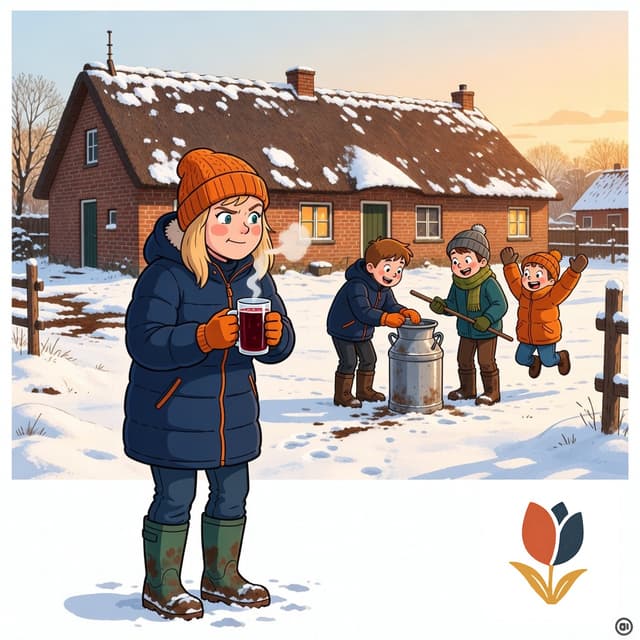
you don't. Sarah is standing behind a boerderij in modderlaarzen she borrowed from Thijs's tante.
She is holding a glass of warme glühwein. She is trying to look like this is completely normal,
it is not going very well. So here is what I want you to listen for in the scene today. First,
listen for how Sarah uses the phrase "oef, dat is hard zeg" after one of the bangs goes off.
That small phrase does a lot of work, it acknowledges the shock, it's honest about the impact,
but it doesn't tip into panic. It keeps her in the conversation. Second, listen for how the
neefje teases her. The phrase is "kom op, niet zo'n bangerd." Bangerd is the word for someone who is scared,
a scaredy cat if you like. When a Dutch teenager says this, it is teasing, but it is also an invitation.
He wants her to stay and try. Third, watch how Sarah deflects the pressure with a question,
"hoe doen jullie dat eigenlijk?" Asking how something works is one of the most underrated moves in Dutch
social situations, it shifts the attention away from you and onto the thing. And Dutch people,
without exception, love explaining how things work. Right. Coat on. Glühwein in hand. Let's go.
Ja dat hoort erbij! Kom je kijken bij de volgende? We laden hem nu weer.
Ik... ja. Ik kom. Even mijn handschoenen aandoen. Handschoenen, haha. Kom op, niet zo'n bangerd hè.
Ik ben geen bangerd! Het is gewoon... het is koud, Daan. Jij hebt een gewatteerde jas aan.
Jij had ook een jas kunnen meenemen. Wij zeiden toch, het is buiten.
Oudejaarsavond is altijd buiten.
Thijs heeft dat misschien niet zo duidelijk gezegd, nee.
Typisch Thijs. Wacht even, ik pak de carbid.
Mag ik zien? Hoe doen jullie dat eigenlijk?
Ohhh, wil je het leren? Okay, kijk.
Je doet een klein beetje carbid in de bus, zo. Niet te veel, want dan is het te gevaarlijk.
Te gevaarlijk? Is er een versie die niet gevaarlijk is?
Haha, ja, de saaie versie.
Luister. Je doet het carbid erin,
dan een klein beetje water, dan doe je de deksel erop en je wacht.
Het gas bouwt op en dan, op het goede moment, houd je een aansteker bij het gaatje.
En dan ontploft het. En dan knapt het, ja.
Ontploft is een beetje groot woord.
Daan, ik heb het gehoord. Dat is ontploffen.
Okay, een klein beetje ontploffen.
Wil je het proberen?
Het aansteken? Ja! Iemand moet het doen.
Oké. Oké dan. Maar als ik mijn wenkbrauwen kwijtraak, vertel ik iedereen dat jij het was.
Dat is eerlijk. Hier, pak de aansteker.
Wacht op het gesis, dan weet je dat het gas er is.
Oef! Oef oef oef. Dat was echt... dat was echt hard zeg.
Jij hebt het gedaan! Je hebt het gedaan!
Ik heb het gedaan. Oh wow. Mijn hart gaat zo snel.
Welkom in Drenthe, Sarah.
She did it.
Wenkbrauwen nog intact.
That scene is one of my favorites because it shows something real about integrating into a Dutch family.
Nobody is going to lower the bar for you.
They're going to stand next to you and expect you to do the thing.
Now, let's pull out the three phrases I want you to take away from tonight.
Take away one.
"Oef, dat is hard zeg."
This is your honest reaction phrase.
Oef is the sound,
Hard means intense or loud here, not difficult.
And zeg at the end is that classic Dutch filler that softens and emphasises at the same time.
Use this whenever something surprises you physically, a cold splash of water,
a sudden noise, an unexpectedly spicy bite.
It sounds natural immediately and it keeps you in the conversation instead of going silent.
Take away two.
"Niet zo'n bangerd hè."
You will hear this.
Probably more than once in your Dutch family life.
A bangerd is a coward, a scaredy-cat.
When someone says this to you, the correct move is not to get defensive.
Do what Sara did.
Protest a little.
Then lean in anyway.
It is an invitation, not an insult.
Take away three.
"Hoe doen jullie dat eigenlijk?"
Learn this sentence by heart.
"Hoe doen jullie dat?"
Is how do you do that?
And eigenlijk is the word that makes it sound genuinely curious rather than just nervous.
When you feel out of your depth in a Dutch family situation,
ask how something works.
You will get a five minute explanation,
and people will remember you as interested and engaged rather than overwhelmed.
Drenthe is extraordinary at this time of year.
Cold, dark, loud, and completely alive.
And next time someone calls you a bangerd,
well, you know what to do.
Tot de volgende keer en een goed oud en gelukkig nieuw.
Settings
Text
Mode
Audio
Pause