
Audio1x
Snelheid
Pauze
OefenenLees
Modus
Woordenschat
Right, parent teacher night, the 10 minute avont,
10 minutes to hear how a child is doing,
sitting in a chair built for an eight-year-old,
trying to decode education Dutch,
while the teacher flips through a portfolio.
Now, if you are partnered with someone who has children
from a previous relationship,
this moment can feel like you are walking a tightrope.
You want to show up, you want to be involved,
but you are not the biological parent.
So how do you position yourself?
How do you signal that you care without overstepping?
The Dutch have a phrase for this.
Meedenken, thinking along.
It is one of those beautiful practical words
that says,
I am not taking over,
I am here to help figure this out together.
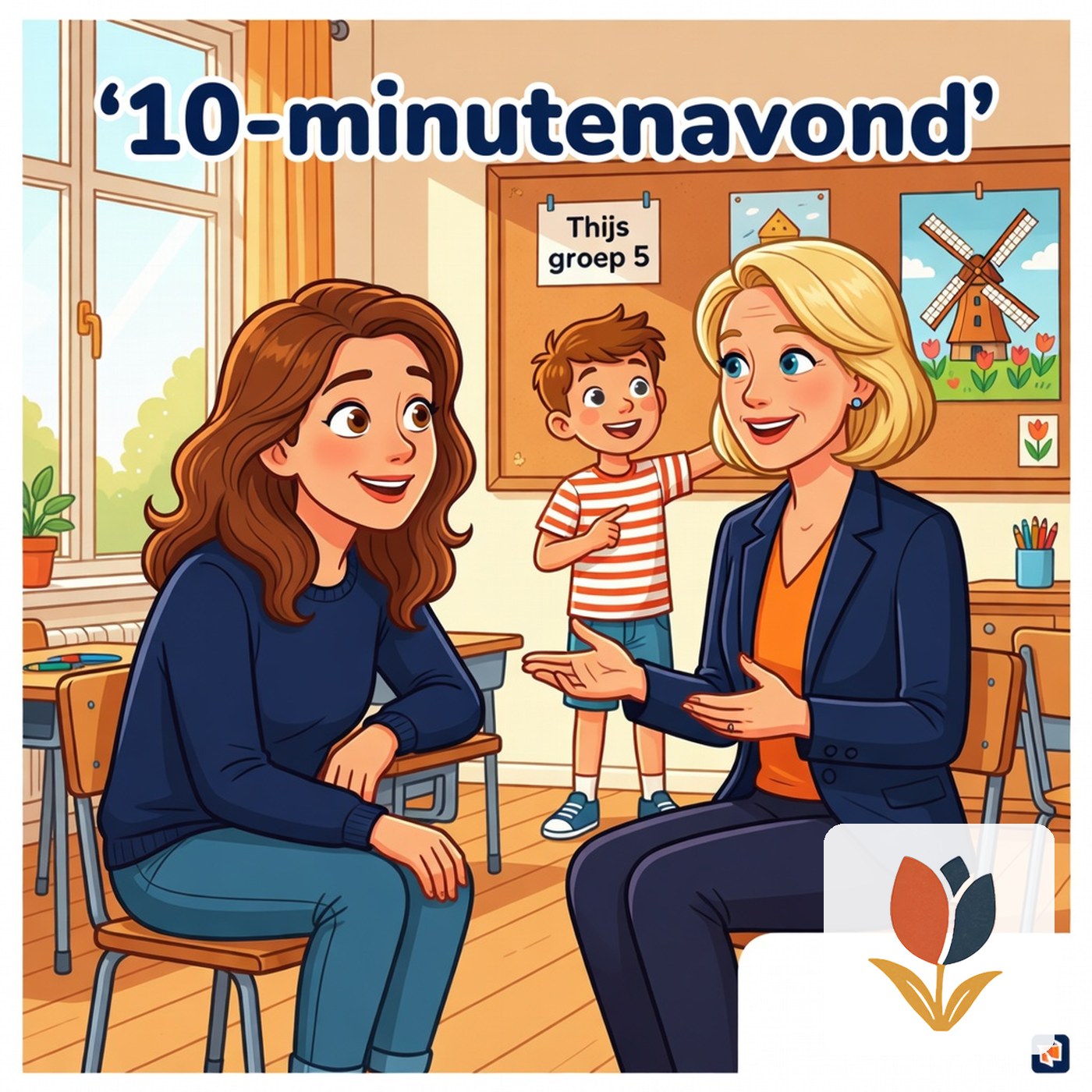
In today's scene,
Sarah is at the 10-minutenavond for groep 5,
Thijs' son from his previous relationship.
The juf is warm but formal,
as teachers often are,
and Sarah has to navigate the language,
the role,
and the relationship all at once.
Three things to listen for.
First, how Sarah positions herself,
not as the mother,
not as just the girlfriend,
but as someone who is part of the team.
The phrasing here matters enormously.
Second, how she asks about process,
not grades.
Dutch schools care less about
cijfers in primary school,
and more about ontwikkeling, development.
If you ask the right questions,
the teacher will open up.
Third, that word again.
Meedenken.
Listen for how Sarah uses it
to signal she is involved,
present,
and willing to help.
It is a small word
that does a lot of heavy lifting.
Let's listen.
Zo, welkom!
Jij bent...?
Sarah. Ik ben de vriendin van vader.
Thijs kan vanavond niet, dus ik kom.
Oh, oké.
Fijn dat je er bent.
Nou, Lars doet het goed hoor.
Hij is een vrolijke jongen.
Ja, dat klopt.
Ehm, hoe gaat het met... zijn ontwikkeling?
Ontwikkeling, ja. Kijk,
hier is zijn portfolio.
Hij doet goed mee met rekenen.
Spelling is... nou ja, dat kan beter.
Spelling.
Oké.
Is dat... normaal voor groep 5?
Ja, voor sommige kinderen wel.
Ja, natuurlijk.
Ehm, waar heeft hij extra hulp bij nodig?
Vooral de lange klinkers.
Je weet wel, aa, ee, oo.
Hij schrijft vaak 'vertel' met één e,
snap je?
Ah, ja. Ik snap het.
En... hoe kan ik hem thuis ondersteunen?
Oh, gewoon lezen samen.
Elke avond tien minuten.
En misschien spelletjes?
Er zijn apps,
maar een woordzoeker werkt ook goed.
Woordzoeker.
Woordzoeker. Oké. Ik ga dat proberen.
En verder gaat het prima.
Hij heeft vriendjes, hij speelt goed buiten,
geen gedoe.
Geen gedoe.
Goed zo.
Ehm, ik wil graag meedenken.
Als er iets is, mag ik ook contact opnemen?
Ja, natuurlijk!
Je bent toch betrokken,
dat zie ik.
Stuur maar een mailtje als je vragen hebt.
Of via Parro,
dat is ons systeem.
Parro.
Oké, ik ga kijken.
Mooi.
En zeg maar tegen Thijs dat hij ook altijd welkom is hoor.
We hebben nog een gesprek in januari,
dan kunnen we verder praten.
Ja, ik geef het door.
Dank je wel.
Graag gedaan.
Fijn dat je gekomen bent!
Ja, tot ziens.
Daag!
There it is.
10 minutes.
Tiny chair.
Big feelings.
Let me pull out 3 phrases you should absolutely memorize
if you are ever in a situation like this.
First. Ik ben de vriendin van vader,
ik wil graag
meedenken.
I'm the girlfriend of the father.
I would like to think along.
This is how you position yourself.
You are not claiming authority.
You are offering partnership.
The teacher hears this and thinks,
Okay, this person is serious.
This person cares.
Second,
Waar heeft hij extra hulp bij nodig? Where does he need extra help?
Notice Sarah did not ask,
What is wrong with him?
She asked where the support is needed.
This is how Dutch teachers think.
They are looking for collaboration.
Not judgment.
Third,
Hoe kan ik hem thuis ondersteunen?
How can I support him at home?
This is the golden question.
It tells the teacher you are not expecting them to fix everything alone.
You are offering to be part of the solution.
And in the Dutch system, that is everything.
One more thing.
Sarah used meedenken. Thinking along.
It is one of those words that signals you understand, Dutch culture.
You are not trying to take over.
You are not passive either.
You are present.
You are involved.
You are willing to figure it out together.
If you are in a blended family,
or even thinking about one day being in that position,
these phrases will serve you well.
Write them down.
Practice them.
Use them.
Tot de volgende keer,
en veel succes!
OefenenLees
Tekst
Modus
Audio
Pauze