

Audio1x
Snelheid
Pauze
OefenenLees
Modus
Woordenschat
Welcome back to Rambl, Dutch for Couples.
I'm Rick, and today we are going into the winkelcentrum.
specifically that little photo booth counter near the supermarket entrance.
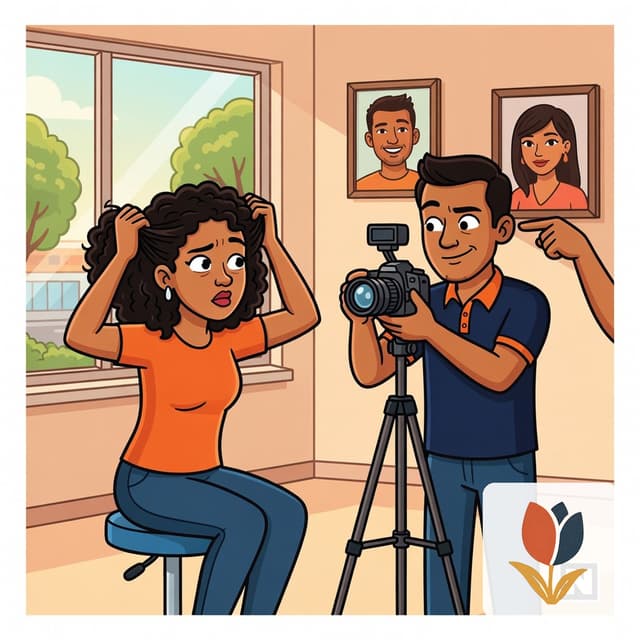
The one with the too-bright lights and the rotating stool that always squeaks.
You need a pasfoto. Simple, right? In theory, yes.
In practice, you are about to enter one of the great Dutch bureaucratic rituals.
Because in the Netherlands, an official photo is not just a photo.
It is a document, and documents have rules.
Many rules. Rules about your ears. Yes, your ears.
They must be visible, both of them.
And if your hair is thick or curly or simply abundant,
you will hear the phrase "oren niet zichtbaar",
more times than feels reasonable for a Tuesday afternoon.
Now, the person behind the counter is not your enemy.
They are doing their job.
But the way Dutch bureaucracy works, they will often distance themselves from the rule entirely.
As if the rule arrived by post and nobody invited it.
Three things to listen for in today's scene.
First, notice how Sarah keeps her patience.
Every time she is sent back to fix her hair, she says something simple and polite.
She does not argue. She resets.
Listen for how she does that.
Second, listen for the moment the medewerker stops apologising
and instead explains himself with a very Dutch deflection.
He separates himself from the regulation completely.
It is a phrase you will hear in many official situations here,
and it is useful to recognise it.
Third, watch how Sarah shifts the dynamic.
She stops asking what is wrong and starts asking for genuine help.
She puts the medewerker in her shoes with a direct question.
It works. It almost always works.
Oh. Sorry. Ik doe het zo.
Oké, ik probeer het nog een keer.
Nee, geen elastiekje. Maar ik kan het zo doen,
met mijn handen achter... nee, dat ziet er raar uit op de foto, toch?
Ja, handen mogen niet zichtbaar zijn. Dat is ook een regel.
Dus ik mag mijn oren niet bedekken, maar ik mag ook mijn handen niet gebruiken om mijn haar vast te houden.
Dat klopt. Het spijt me, maar zo zijn de regels nu eenmaal.
Maar... waarom zijn de oren zo belangrijk?
Ik begrijp het niet helemaal.
Het is voor gezichtsherkenning. Bij grenscontroles, dat soort dingen.
Maar kijk, ik snap dat het vervelend is.
Het is niet ik, het is de regelgeving.
Ik kan het ook niet anders maken.
Nee, nee, ik begrijp het. Echt waar.
Oké, ik probeer het nog een keer.
Bijna.
De linker oorschelp is zichtbaar. De rechter... nog net niet helemaal.
Ziet u het op het scherm?
Ja, ik zie het.
Jeetje. Mijn haar is echt te dik voor dit.
U bent zeker niet de eerste, hoor.
Dat geloof ik graag.
Eh... mag ik u iets vragen?
Natuurlijk.
Wat zou u zelf doen in mijn plaats? Als u dit haar had?
Is er een truc?
Ha. Goede vraag.
Eerlijk gezegd... wat mensen soms doen, is de haren achter de oren stoppen
en dan de oren een klein beetje naar voren vouwen.
Klinkt raar, maar het werkt.
En als u een pen heeft, kunt u die gebruiken om het haar
tijdelijk plat te houden net buiten beeld.
Ik kijk weg.
U kijkt weg.
Ik kijk weg.
Zo?
Even kijken. Proeffoto... ja.
Ja, nu wel.
Beide oren zichtbaar. Mooi.
Kijkt u even recht in de lens?
Mond dicht, neutrale uitdrukking.
Geen glimlach?
Geen glimlach.
Sorry.
Nog een regel.
Nog een regel.
Klaar?
Drie,
twee...
Uitstekend.
Die is goed.
Ik print ze even voor u.
Eindelijk.
Dank u wel.
En sorry voor het gedoe.
Geen probleem, hoor.
Succes met de vergunning.
Dank u.
Fijne dag nog.
U ook.
Right.
Four attempts.
Two ears.
One very patient Sarah.
If you have ever stood under those
winkelcentrum lights and been sent back to the stool
for the third time,
today's scene was probably very familiar.
Let us pull out the three phrases that matter.
Number one.
Oké, ik probeer het nog een keer.
Simple, calm, effective.
Sarah uses this every time she is redirected
and it does something important.
It signals that she is cooperative,
not frustrated.
In Dutch bureaucratic encounters,
showing that you are willing to try again
buys you good will.
The person behind the counter relaxes.
They start to help rather than enforce.
Those seven words cost you nothing
and they change the whole atmosphere.
Number two.
Het is niet ik.
Het is de regelgeving.
You will hear this a great deal in the Netherlands.
At the gemeente, at the IND,
at the Belastingdienst,
a Dutch official separating themselves
from the rule they are applying.
It is not passive aggression.
It is genuine.
They often feel it too.
When you hear it,
do not push back against the person.
Push back against the process
or better yet,
ask how to work within it.
Number three.
Wat zou u zelf doen in mijn plaats?
This is the phrase that unlocks
the unofficial knowledge.
Every person who works in a rule bound job
has a small collection of workarounds
they cannot officially recommend.
This question gives them permission
to share those workarounds
without putting themselves on the line.
It is respectful.
It is curious.
And it almost always gets you something useful.
A pen held just out of frame, apparently.
Tot de volgende keer en vergeet niet.
Je oren zijn zichtbaar.
Je verblijfsvergunning is onderweg.
Aanpassen
Tekst
Modus
Audio
Pauze