
Audio1x
Snelheid
Pauze
OefenenLees
Modus
Woordenschat
Right. Let's talk about something nobody wants to do in a second language.
Apologizing.
When you argue with your Dutch partner in Dutch, everything feels bigger,
rawer. You're already working harder to find words.
Your emotions are running high, and then when it's over,
when the silence sets in, you have this choice.
Do I say sorry in English?
Where I know exactly how it will land?
Or do I stay in Dutch where it started?
Here's the thing.
If your fight was in Dutch, your apology needs to be in Dutch too.
Not because Dutch people are stubborn about language,
but because switching to English makes it feel like you're stepping out of the relationship
and commenting on it from the outside.
You're not in it anymore.
You're narrating it.
And I know what you're thinking.
My Dutch isn't good enough for something this important.
I'll sound like a child.
I won't be able to say what I really mean.
But that's exactly why it matters.
Apologizing in your second language is vulnerable.
It's slower.
It forces you to focus on what actually needs to be said
instead of over-explaining or defending yourself in three different ways.
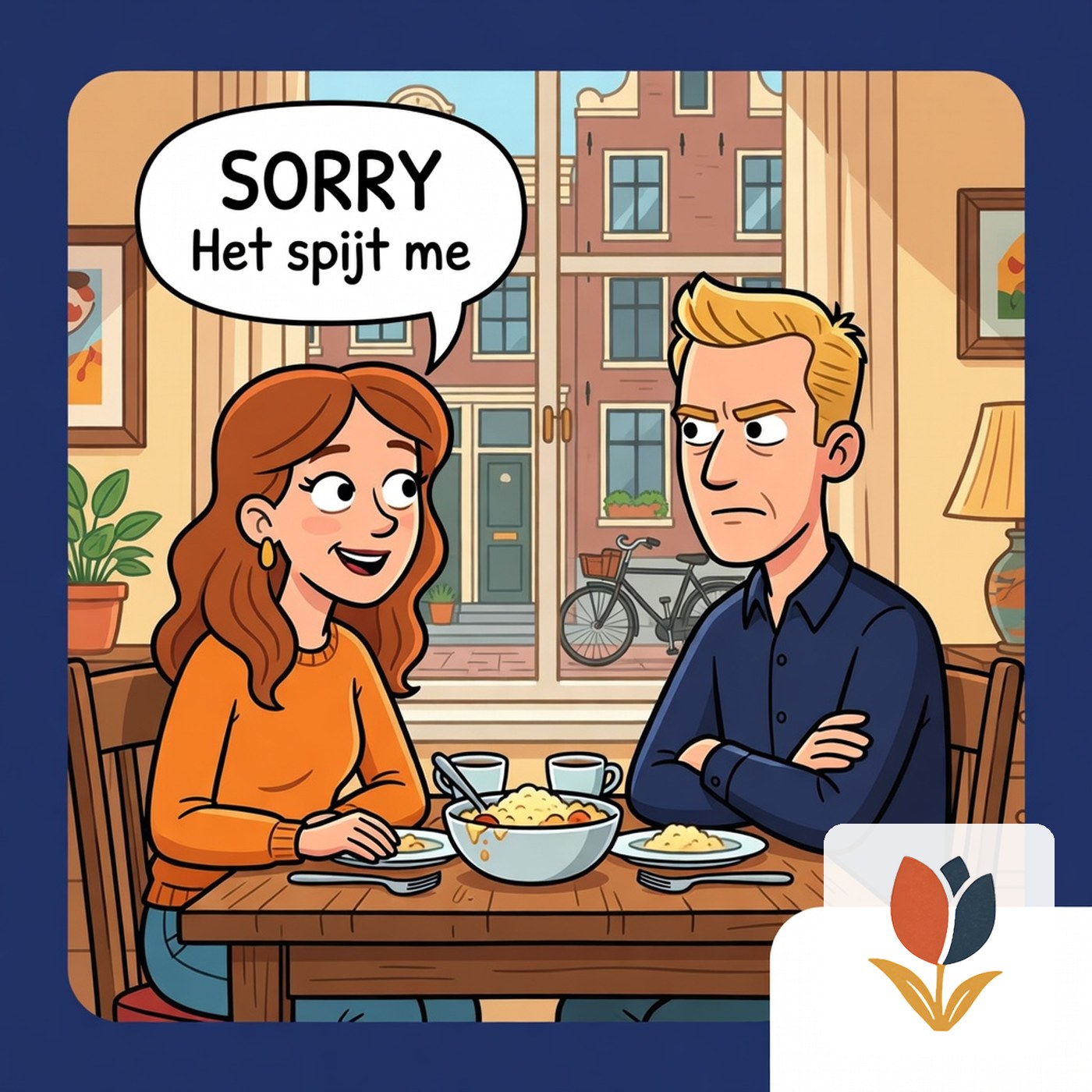
In today's scene, Sarah and Thijs have been arguing.
Dinner is quiet.
Painful.
She knows she needs to say sorry,
and she's going to do it in Dutch.
Here's what I want you to listen for.
One, how Sarah takes responsibility without over-apologizing?
Dutch people can smell false modesty.
You don't need ten sentences.
You need one honest one.
Two, how she names what she wants instead of what she regrets.
This is key.
Don't just list your mistakes.
Say what you actually wanted to happen.
Three, how she asks for a reset.
Not forgiveness.
Not permission.
Just can we try this again?
Let's listen.
Wil je nog meer?
Nee, dank je.
Oké.
Het is lekker.
Thijs, ik... Sorry.
Sorry, dat was niet eerlijk.
Wat ik zei. Over jouw moeder. Dat was... dat was te ver.
Ik was boos,
en ik zei dingen die... die niet waar zijn.
Ik bedoelde het niet zo.
Je zei het wel.
Ja. Ik zei het.
En dat was fout.
Ik wilde eigenlijk zeggen dat ik me...
hoe zeg je...
Overwhelmed?
Overweldigd.
Overweldigd,
ja.
Ik voelde me overweldigd. Door alles.
En in plaats van dat te zeggen, deed ik... dit.
Je hoeft niet in het Nederlands te praten als je...
Nee, ik wil in het Nederlands praten.
We vochten in het Nederlands.
Dus... dit ook.
Oké.
Ik weet dat ik soms... dat ik soms dingen zeg die te hard zijn.
Omdat ik niet alle woorden heb.
Dus ik kies grote woorden.
Gemakkelijke woorden.
Boze woorden.
Dat begrijp ik.
Maar dat is geen excuus.
Ik kan ook zeggen, wacht even,
ik weet niet hoe ik dit moet zeggen.
Dat is beter. Toch?
Toch?
Ja. Dat is beter.
Ik wilde eigenlijk zeggen dat ik me alleen voelde.
Niet boos. Alleen.
En ik wist niet hoe.
Je voelde je alleen.
Ja. Omdat jij zo veel tijd met je werk bezig bent,
en met... met iedereen.
En ik zit hier.
En ik probeer,
maar het is moeilijk.
En in plaats van dat te zeggen,
maakte ik het over jouw moeder.
Wat... stom was.
Het was gemeen.
Het was gemeen.
Sorry.
Oké. Dank je.
Kunnen we het opnieuw proberen? Morgen.
Of nu.
Gewoon... opnieuw beginnen?
Ja. Dat wil ik ook.
Goed.
En Sarah?
Ja?
Als je je alleen voelt... zeg het.
Gewoon zeggen.
Ik luister.
Oké.
Ik zal het proberen.
En ik zal beter...
hoe zeg je dat...
aanwezig zijn.
Meer here.
Hier.
Meer hier zijn.
Meer hier zijn.
Ja.
Dank je.
Wil je nu meer eten?
Ja. Een beetje.
Goed.
Het is koud geworden, maar...
Het is nog steeds lekker.
Oké.
Mooi.
Right.
That was hard to listen to, wasn't it?
That silence at the start.
The weight of it.
But Sarah stayed in Dutch.
She didn't run to English when it got uncomfortable.
And that's what made the apology real.
Let's pull out three phrases you need to memorize.
Not for arguments, I hope.
But for those moments when you've said something wrong
and you need to make it right.
One.
Sorry.
dat was niet eerlijk.
Sorry.
That wasn't fair.
Simple.
Direct.
No excuses attached.
You're not saying sorry for having feelings.
You're saying sorry for what you did with them.
That precision matters.
Two.
Ik wilde eigenlijk zeggen dat...
I actually wanted to say that...
This is where you name the real feeling underneath the fight.
Not what you regret saying.
What you were trying to say.
This phrase gives you a second chance to be honest.
Kunnen we het opnieuw proberen?
Can we try this again?
Not.
Will you forgive me?
Not.
Can we pretend this didn't happen?
Just.
Can we reset?
It's a question.
It respects the other person's space
and it keeps the door open.
Here's the truth.
Apologizing in Dutch won't feel as smooth
as apologizing in English.
You won't have all the right words.
You'll sound simpler, maybe even blunt,
but that's the point.
When you apologize in your second language,
you can't hide behind eloquence.
You can't perform.
You just have to say what's true.
And your Dutch partner will hear that.
They'll hear the effort, the vulnerability,
the fact that you stayed in the language of the fight
instead of retreating to the language of comfort.
That's intimacy.
That's what makes relationships work
across languages.
Tot de volgende keer en veel sterkte.
OefenenLees
Tekst
Modus
Audio
Pauze