
Audio1x
Speed
Pause
PracticeRead
Mode
Woordenschat
Welcome back to ramble, I'm Rick and today we're getting into something that sounds trivial
but is I promise you absolutely loaded with cultural weight. We are talking about
Hagelslag, chocolate sprinkles on bread, a Dutch institution, a daily ritual,
and for many expat partners a quiet little battleground. Here is the thing about hagelslag,
it is not just a topping, it is a whole procedure. You take real butter, not margarine,
you spread it generously, and then you pour the hagelslag on so thickly that it stays in place when
you lift the bread. There is a technique, there are opinions, and those opinions belong to the
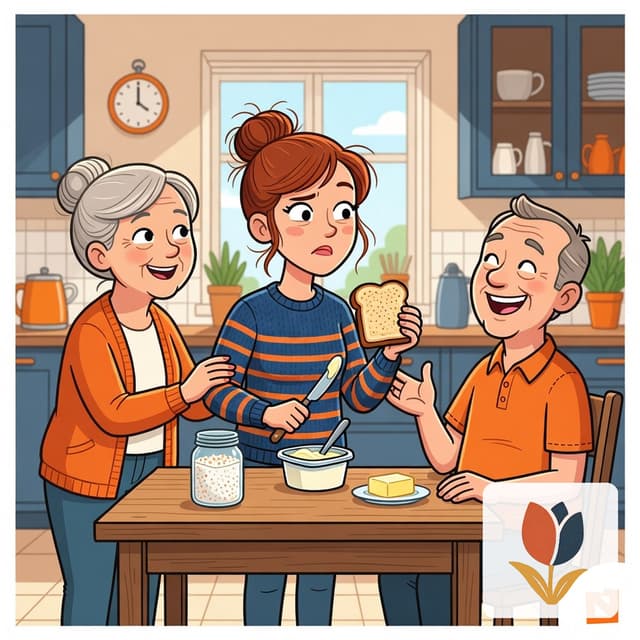
family. Today's scene takes place on a Saturday morning at Sarah's schoonfamilie's house. Sarah
makes her own toast, her own way, with margarine and what her schoonmoeder considers an embarrassingly
light dusting of hagelslag, and then very kindly, very Dutch-ly, schoonmoeder says something.
Listen for three things. First, notice how Sarah uses the phrase,
ach, ik vind het zo lekker to soften her position. She is not arguing, she is just expressing herself
warmly, and that little word ach, does a lot of the work. Second, count how many times schoonmoeder says
ja maar, it happens three times in under 30 seconds, that is not rudeness, that is Dutch rhythm. Third,
watch how Sarah closes the whole thing down with a joke. Ik probeer het nog te leren. Brilliant.
She disarms the situation completely with self-deprecating humour, and everyone can breathe again.
Ready? Let's go to the kitchen.
Pak maar gerust een paar boterhammen, hoor. Het brood staat daar, en de hagelslag zit in die rode trommel.
Oh, dankjewel. Ik doe het zelf wel even.
O, wacht even, Sarah, dat is de halvarine. De boter is daar, in het gele bakje.
Ah. Nee, eigenlijk vind ik halvarine lekkerder. Minder zwaar, toch?
Halvarine? Op hagelslag? Ja maar, je proeft echt het verschil, hoor.
Boter geeft de hagelslag iets om aan vast te zitten.
Met halvarine glijdt het er zo af.
Ach, ik vind het zo lekker. Echt. Ik eet het thuis ook altijd zo.
Ja maar, thuis is thuis. Hier is goede boter.
Vers van de boer, bijna. Het zou zonde zijn.
Zonde?
Nou ja, je mist de smaak. En kijk, je doet ook zo weinig hagelslag. Kijk dan. Dat is bijna niks.
Ik vind dit genoeg eigenlijk.
Ja maar, Sarah, hagelslag hoort er gewoon dik op.
Anders is het gewoon brood met een vleugje chocola.
Dat is toch geen hagelslag?
Misschien is dat mijn versie van hagelslag.
Jouw versie.
Zal ik even...
Nee nee, ik heb het al zo.
Echt.
Ach, ik vind het zo lekker, precies zo.
Het is een kwestie van smaak, toch?
Hmm. Dat zeg jij.
Ja, dat zeg ik.
Maar misschien heb jij ook een beetje gelijk.
Ik weet het niet.
De Nederlandse hagelslag-traditie is ingewikkeld voor mij.
Ingewikkeld?
Het is gewoon boter en hagelslag, hoor.
Ja, maar voor mij is het nieuw.
Ik probeer het nog te leren.
Dat is lief, hoor.
Kom, ik zal je laten zien hoe het hoort.
Oké. Maar ik houd halvarine, hoor.
Tja. Pap, doe normaal.
What a scene.
And if you recognize that kitchen, that tin, that look,
then you know exactly what Sarah was navigating.
Let's pull out the three phrases that carried the whole conversation.
Number one.
Ach, ik vind het zo lekker.
This is your soft disagreement phrase.
You are not saying the other person is wrong.
You are just anchoring yourself in your own experience.
The word ach is crucial.
It signals warmth, a little wistfulness, a gentle shrug.
It keeps the door open.
Memorize this one.
You will use it constantly.
Number two.
Het is een kwestie van smaak.
It is a matter of taste.
This is your elegant exit from any food or preference debate.
It sounds thoughtful.
It sounds adult.
And it completely neutralizes the argument
without either side losing face.
Dutch people will respect this phrase.
It is the kind of thing they might say themselves.
Number three.
Ik probeer het nog te leren.
I am still learning it.
This one is a gift.
It is self-deprecating without being self-pitying.
It is honest.
And it hands the Dutch person something they love,
which is the role of the patient, wise guide.
Sarah used it to end a standoff
and turn it into a moment of warmth.
That is not luck.
That is skill.
Sarah kept her halvarine, by the way.
Small victories.
Tot de volgende keer.
En smeer je boterham lekker dik.
Settings
Text
Mode
Audio
Pause