
Audio1x
Snelheid
Pauze
OefenenLees
Modus
Woordenschat
Hello everyone, welcome back to Ramble, I'm Rick.
Today we're going into a situation that many of you will face eventually,
but one that nobody prepares you for, the funeral reception.
What we call de koffietafel.
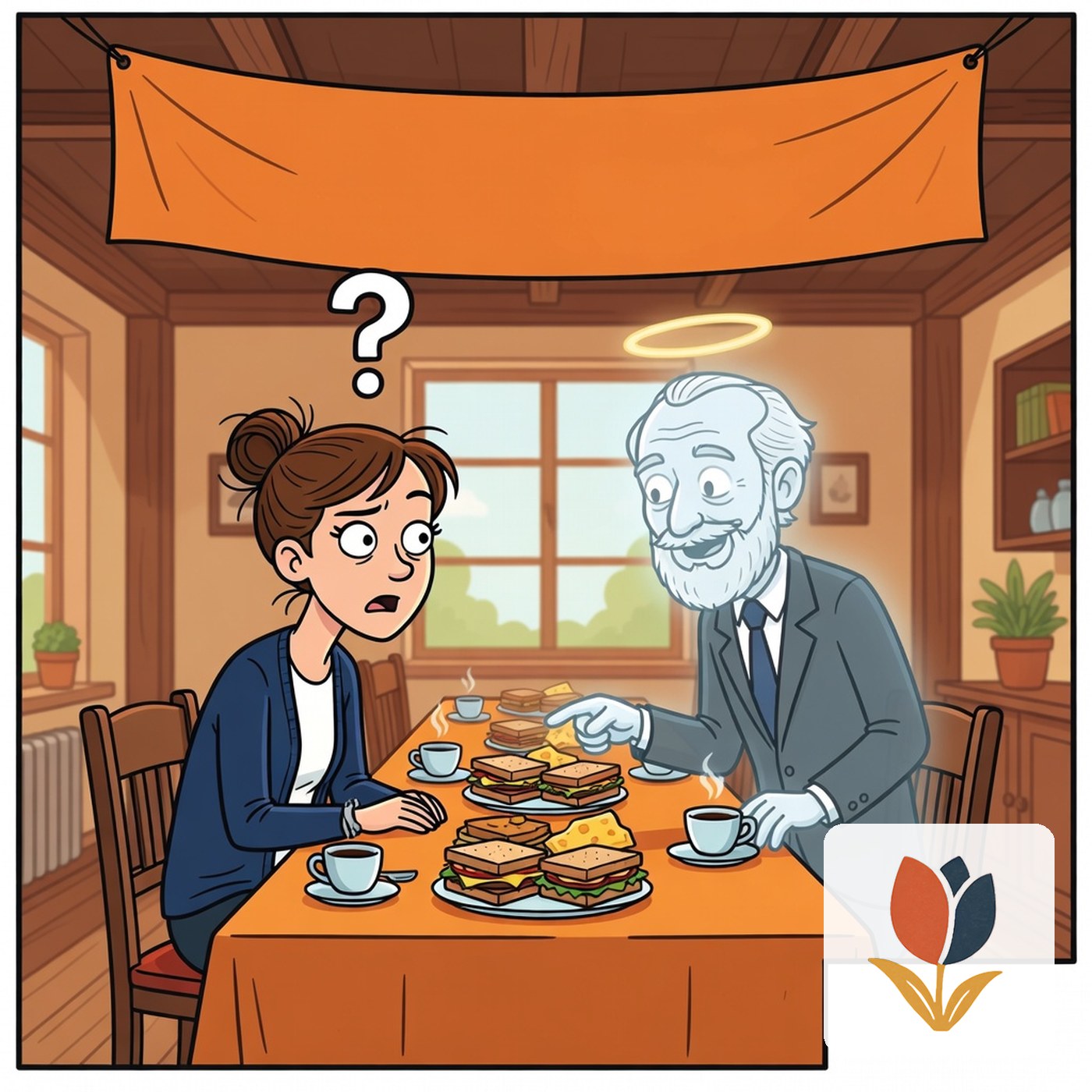
Thijs' great-uncle has passed away,
and Sarah is about to navigate her first Dutch funeral gathering.
Now I know this feels daunting.
You're anxious about saying the wrong thing.
Worried your Dutch will fail you at a sensitive moment,
but here's what I want you to understand.
Dutch funeral language is actually a gift to learners.
It's formulaic, it's predictable.
There are set phrases that everyone uses,
and nobody expects poetry from you.
The worst thing you can do? Overcompensate.
Try to be eloquent, fill the silence with nervous chatter.
Dutch condolences are brief, direct,
and repeated by everyone in the room.
You're not performing, you're participating in a ritual.
In today's scene, Sarah meets the widow at the coffee table.
She's nervous, but she has three things working in her favour.
First, she knows the key phrase and when to use it.
Second, she understands that less is genuinely more in this context.
And third, she's prepared for the question that always comes.
How did you know him?
So as you listen to part two, pay attention to three things.
One, how Sarah uses 'gecondoleerd' correctly at the right moment.
Two, how she says less, not more, keeping it simple and heartfelt.
And three, how she handles 'hoe kende u hem?'
When the widow asks how she knew the deceased.
Let's listen to Sarah at the koffietafel.
Thijs, ik weet niet wat ik moet zeggen. Wat is... correct?
Gewoon 'gecondoleerd' zeggen tegen tante Riet. En haar hand vasthouden. Meer niet.
Kom.
Oké. Oké.
Tante Riet, dit is Sarah.
Ah, Sarah. De vriendin uit Engeland?
Ja. Gecondoleerd, mevrouw. Heel veel sterkte.
Dank je wel, lieverd. Dank je wel. Fijn dat jullie er zijn.
Het is... ik vind het erg voor u.
Ja. Het was zijn tijd, hoor. Hij was 91. Maar toch.
Ja. Toch.
Kende je Henk?
Hebben jullie elkaar ontmoet?
Nee, helaas niet.
Ik ben de vriendin van Thijs, en eh...
Thijs vertelde veel over hem.
Ah, juist. Thijs. Natuurlijk.
Henk was dol op Thijs, weet je. Altijd vragen naar hem.
Dat hoorde ik, ja.
Hij was een bijzondere man,
hoorde ik veel over hem.
Bijzonder, ja.
Dat was hij zeker.
Koppig ook, hoor.
Verschrikkelijk koppig.
Dat... dat is familie, denk ik?
Ha! Ja, dat klopt.
Alle mannen in die familie. Even koppig.
Tante?
Jij ook, Thijs. Net je opa.
Net Henk.
Maar goed.
Willen jullie koffie? Cake?
Er is genoeg, hoor.
Graag, dank u wel.
En jij spreekt al Nederlands!
Knap hoor. Hoe lang ben je hier nu?
Drie jaar nu.
Mijn Nederlands is niet... niet zo goed nog.
Nee joh, het gaat prima.
Henk zou het leuk vinden.
Hij hield van buitenlanders, weet je.
Hij werkte bij Philips, overal geweest.
Canada, Amerika, Singapore.
Echt waar?
Wat interessant.
Ja. Hij sprak zelfs een beetje Chinees,
geloof het of niet.
Een paar woorden maar. Voor de lol.
Dat wist ik niet eens, tante.
Nee? Ach, er is zoveel.
68 jaar samen, jongen.
Je kunt niet alles vertellen.
Ga maar koffie halen, allebei.
En neem vlaai. Die is van de echte bakker.
Dank u wel.
En nogmaals, gecondoleerd.
Lief van je. Dank je wel, Sarah.
So Sarah made it through.
And she did it by understanding something crucial about Dutch funeral culture.
The ritual protects you.
Let's look at what she actually said.
Because these are your takeaway phrases for any funeral or condolence moment.
Takeaway number one, gecondoleerd.
Heel veel sterkte, condolences and wishing someone strength.
This is the phrase.
You say it when you first greet the bereaved.
You can say just gecondoleerd, but adding
Heel veel sterkte is warm and complete.
Sarah used it perfectly right at the start.
Takeaway number two, ik ben de vriendin van.
I'm the girlfriend of.
I'm the partner of.
I'm the colleague of.
When someone asks how you knew the deceased
and you didn't actually know them, this phrase saves you.
You're identifying your connection through someone else.
It's honest and it's enough.
Sarah used it when the widow asked if she'd met Henk.
Takeaway number three, hij was een bijzondere man.
Hoorde ik veel over hem.
He was a special man.
I heard a lot about him.
This works when you're acknowledging someone you never met.
It's respectful.
It's kind.
And it invites the other person to share a memory
which is often exactly what they need.
Notice what Sarah didn't do.
She didn't apologize for her Dutch.
She didn't launch into a long explanation.
She didn't try to be funny or fill every silence.
She used the ritual phrases.
She was present and she let Riet talk.
Dutch funerals can feel stiff, especially the koffietafel moment.
But that formality is actually there to help everyone,
including you.
Lean into it.
Use the set phrases.
Say less.
Your presence matters more than your vocabulary.
Tot de volgende keer.
En heel veel sterkte als je dit ooit nodig hebt.
OefenenLees
Tekst
Modus
Audio
Pauze