

Audio1x
Speed
Pause
PracticeRead
Mode
Woordenschat
Right, Kings Day, Kerning's Day.
The one-day year when the entire country turns orange,
goes outside and sells their rubbish to each other.
It's brilliant, really.
No permits needed.
You just lay a blanket on the pavement,
dump out your old stuff, and suddenly you're a shopkeeper.
Now, if you're an expat partner in the Netherlands,
this can be a bit nerve-racking.
You're sitting on the ground with a pile of secondhand books
and broken toys, and Dutch people are going
to walk up and try to get you to lower your prices
in rapid-fire street Dutch, with strangers you'll never see again.
But here's the thing.
This is actually fantastic practice,
because vrijmarkt Dutch is short, direct, and very forgiving.
Nobody expects poetry.
They expect a price, a quick back and forth and a deal.
If you mess up a word, they just move on to the next blanket.
Low stakes, high volume.
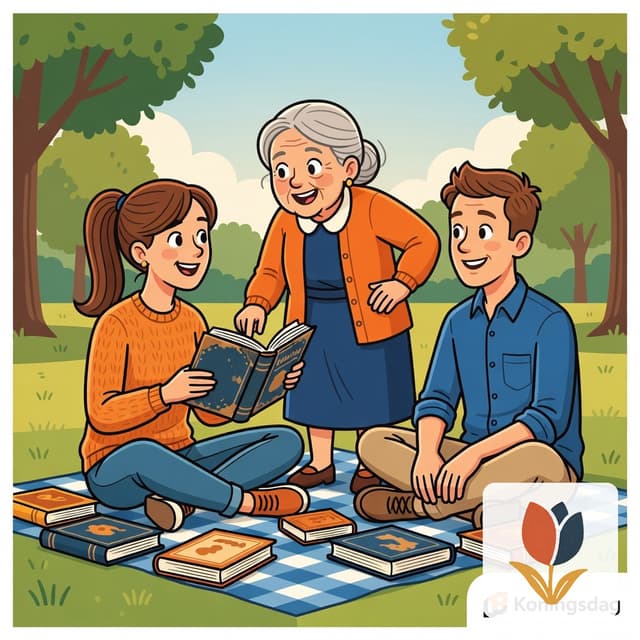
Sarah is doing her first vrijmarkt today
with Thijs' old study books.
She's nervous.
Thijs has wandered off to buy stroopwafels, naturally,
so she's on her own.
And here comes an older Dutch woman who wants to haggle.
Three things to listen for.
One, how Sarah names a price and sticks to it.
Two, how she uses doe maar as a magic phrase to close the deal.
And three, how she wraps up the sale in just three words.
Let's listen.
Alles twee euro, of drie voor vijf euro.
Dag, meisje. Deze boeken hier, dat is van de universiteit, toch?
Ja, eh, rechten. Van mijn partner.
Rechten, oké. Hm.
Hij is klaar gestudeerd?
Ja, vorig jaar. Dus... we hebben de boeken niet meer nodig.
Natuurlijk, natuurlijk.
En hoeveel wil je ervoor?
Twee euro per stuk.
Twee euro. Hm.
Voor zo'n dik boek?
Ja, twee euro.
Maar kijk, hier staat ook...
hier zit een vlek op de achterkant, zie je?
Oh, sorry, ja, een beetje.
Kan het iets minder?
Eh... nee, twee euro is al goedkoop, denk ik.
Ja, maar het is wel tweedehands, hè. En die vlek.
Ja, maar... het is Koningsdag.
Alles is tweedehands vandaag.
Ha, dat is waar.
Slim meisje.
Oké, wat als ik er drie neem?
Kan je me dan een mooie prijs geven?
Drie voor vijf euro.
Vijf euro. Hm.
Vier euro?
Nee, sorry.
Vijf euro voor drie.
Jeetje, je bent hard, zeg.
Waar kom je vandaan?
Engeland.
Ah, Engels.
Je spreekt goed Nederlands, hoor.
Dank je.
Maar vijf euro, dat is nog steeds veel.
Het... het is een goede prijs.
De boeken waren heel duur nieuw.
Ja, ja, dat geloof ik.
Maar niemand koopt studieboeken op Koningsdag, schat.
Kijk, ik geef je vier euro voor drie boeken,
en dan ben je van ze af.
Nee. Vijf euro.
Vier vijftig? Vijf.
Goed, goed. Vijf euro.
Je wint.
Hier.
Twee euro,
doe maar... eh, nee, sorry. Vijf euro, doe maar.
Nee, sorry.
Vijf euro.
Doe maar...
Ha, bijna.
Alsjeblieft, vijf euro.
Dank je.
Dank je,
fijne Koningsdag.
Jij ook, meid.
En volgende keer, doe maar vier euro, hè?
Dan verkoop je meer.
Misschien. Doei! Doei.
Right, let's talk about what just happened there.
Sarah held her ground.
The koper, the buyer, tried every trick in the book.
The vlek, the stain.
The appeal to logic nobody buys textbooks at a vrijmarkt.
The, you're so smart, but also please lower your price routine.
Classic Dutch haggling.
And Sarah just kept saying,
Twee euro, vijf euro.
Nee, short, clear, unapologetic.
Three things to take away from this.
First, when you name your price, you can lock it in with doe maar.
Sarah almost said,
Twee euro, doe maar, by mistake.
But then corrected herself.
Doe maar literally means just do it.
But in a sales context, it's more like,
let's make it happen or go on then.
It's a tiny phrase that closes the loop.
You say the price, you say doe maar.
And you've made the decision feel easy and final.
Second, the buyer's key question was,
Kan het iets minder?
Can it be a bit less?
Not, kan ik korting krijgen?
Can I get a discount?
Not, is dat je laatste prijs?
Is that your final price?
Just, can it be less?
That's the Dutch haggling opener.
Soft, polite, hopeful.
And you can just say,
Nee, you don't need a speech.
Sarah said,
Nee, twee euro is al goedkoop.
That's enough.
Third, Sarah's closing line.
Dank je, fijne Koningsdag.
Thank you.
Have a nice kings day.
Three words after, dank je.
That's how you close a transaction with a stranger on the street.
Friendly, warm, done.
You're not writing a letter.
You're not making a new friend.
You're just being a decent human and moving on.
One more thing.
The buyer said,
Je wint, you win.
That's what Dutch people say when they agree to your price.
It's playful.
It's not real defeat.
It just means,
Okay, you stuck to your guns.
I respect that.
Here's my money.
Don't feel bad.
That's how the game works.
Next time you're at a vrijmarkt or a markt or anywhere
someone selling something on a blanket,
try it.
Name a price.
Say,
Doe maar,
close with
Fijne dag.
You'll be fine.
Succes, en tot de volgende keer.
Succes, en
Tot de volgende keer.
Settings
Text
Mode
Audio
Pause