
Audio1x
Speed
Pause
PracticeRead
Mode
Woordenschat
Welcome back to Rambl. I'm Rick and today we are going into territory that every expat in the Netherlands will recognize the Buurt app.
If you don't know what that is, it is a neighbourhood chat group, usually on WhatsApp or a local app, where Dutch neighbours coordinate things like lost cats, suspicious vans and, most importantly, their feelings about parking.
And those feelings are strong. Now here is the thing about Dutch passive-aggressive politeness.
On the surface, it looks incredibly reasonable, polite even. But underneath, it is not a request, it is a verdict. And if you are not a native speaker, you can miss that entirely.
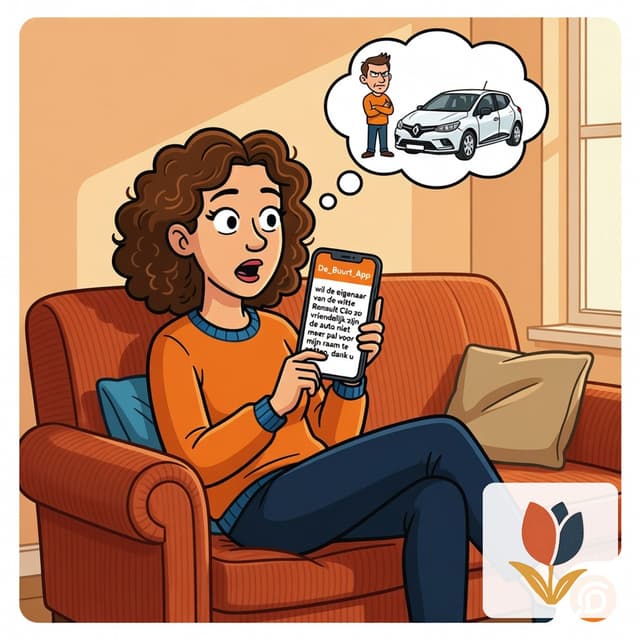
Tonight's scene. Sarah is on the sofa scrolling the Buurt app, and she finds a post.
Someone is asking very politely whether the owner of a white Renault Clio would be so kind as not to park directly in front of their window.
The Clio is Sarah's. She goes and knocks on the door. I want you to listen for three things. First, notice how Sarah takes responsibility immediately without groveling.
She uses a clean, adult apology: "Mijn excuses, ik wist niet dat dat een probleem was." No drama, no over-explaining.
Second, listen for how she turns the situation into a practical question rather than a standoff.
She asks: "Waar mag ik wel parkeren volgens jou?" That word "wel" is doing a lot of work there. It flips from the negative to the positive. Not where can't I park, but where can I.
Third, watch how she closes the conversation warmly. She uses a phrase that Dutch people use to signal that a difficult thing has been handled like adults.
It is a small social seal. It says: we're fine. Right. Let's go and knock on Henk's door.
Ja? Oh. Hoi. Goedenavond. U bent Henk, toch? Ik ben Sarah, ik woon op nummer zeven.
Ja, dat weet ik. Kom je over de... nou, over de auto?
Ja. Ik zag uw berichtje op de buurt-app. De witte Clio, dat is mijn auto. Mijn excuses, ik wist niet dat dat een probleem was.
Nou, ik wilde het even netjes vragen, hoor. Niet meteen... je weet wel. Nee nee, ik begrijp het.
Maar ik wist echt niet dat die plek voor uw raam lastig was. Staat hij al lang zo?
Sinds vorige week dinsdag, ja. Ik zie niks meer vanuit de woonkamer. Niks.
Het is gewoon... het is niet ideaal, zal ik maar zeggen. Dat snap ik. Dat is vervelend.
Waar mag ik wel parkeren volgens jou?
Nou, kijk, de plekken aan de overkant zijn eigenlijk... die zijn vrij, meestal.
Of een stukje verderop, na de boom. Daar staat bijna nooit iemand.
Goed. Na de boom, na nummer twaalf ongeveer?
Zoiets ja. Of gewoon aan de overkant. Dat is... dat is prima.
Oké. Dan doe ik dat voortaan. Ik zet hem vanavond nog weg.
Dat hoeft niet per se vanavond hoor, het is al...
Nee, ik doe het toch even. Dan is het geregeld.
Dat is... ja. Dat is aardig van je.
Ik had misschien ook gewoon kunnen aanbellen, eerlijk gezegd.
Nou, de buurt-app is ook prima hoor.
Maar ik vind het fijn dat we het even konden uitspreken.
Ja. Ja, dat is wel zo prettig, zeg.
Sommige mensen reageren helemaal niet, dan blijft het gewoon op de app staan en...
Ja, dat lijkt me niet zo gezellig.
Nee. Nee, precies. Nou, goed dan. Bedankt dat je even langs bent gekomen.
Geen probleem. Welterusten, Henk.
Welterusten. En eh...
Welkom in de buurt, eigenlijk.
Beetje laat, maar toch.
Dank je wel. Dat meen ik.
That went well.
And it went well for specific reasons.
Let's pull them apart.
First, notice that Sarah did not get defensive.
She did not say, but I didn't know there was a rule.
Or the parking is public anyway.
She just acknowledged the situation.
That is exactly what take away number one is for.
Take away one.
Mijn excuses.
Ik wist niet dat dat een probleem was.
My apologies.
I didn't know that was a problem.
Clean, direct, no drama.
Dutch people respond very well to this.
It is not weakness.
It is social efficiency.
Take away two.
Waar mag ik wel parkeren volgens jou?
Where can I park in your view?
Two things happening here.
The word "wel" redirects to a positive solution.
And "volgens jou" invites Henk to be the expert on his own street.
He knows where the spaces are.
Let him tell you.
People love being useful.
Take away three.
Fijn dat we het even konden uitspreken.
Lovely that we could have a little talk about it.
This phrase is a social gift.
It reframes what could have been a confrontation
as something mature and neighborly.
Henk immediately softened when he heard it.
You heard him admit he could have just knocked on the door himself.
One last thing.
Henk's post on the buurt-app, "zo vriendelijk zijn,"
sounds polite in translation.
But in Dutch, neighborly culture, that phrasing is firm.
It means stop.
Learning to read that register and to respond to it calmly
rather than anxiously, is one of the real skills of living here.
Right.
That is episode 38.
Share it with your partner.
Ask them what they would have posted on the buurt-app.
The answer will tell you a lot.
Tot de volgende keer.
En zet je auto na de boom.
Settings
Text
Mode
Audio
Pause