
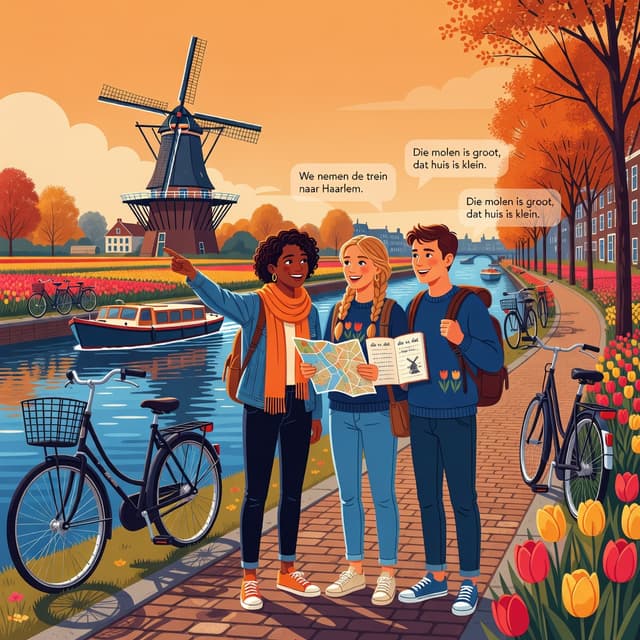
Een uitstapje buiten Amsterdam

Audio1x
Speed
Practice
Woordenschat
Since you are living and working right in the heart of Amsterdam as a professional, I imagine you sometimes want to escape the busy city for a quiet weekend.
You told me earlier that your goal is to speak Dutch really well—you said, 'Ik hoop dat ik heel goed Nederlands kan spreken'—and part of reaching that B1 level is being able to navigate the rest of the country, far outside the Amsterdam bubble.
So today, let's prepare you for an adventure outside the city.
We are going to talk about making an uitstapje.
An uitstapje is a little day trip or excursion.
It is a very common and cheerful word here.
You might say to your colleagues on Monday morning: 'Ik heb dit weekend een leuk uitstapje gemaakt.'
When you plan an uitstapje in the Netherlands, you will almost certainly use the train.
And dealing with the NS—the Dutch railways—is a true cultural rite of passage.
Before you even reach the station, you need to check your OV-chipkaart.
You have to opladen it.
Opladen means to charge or to top up.
You need enough balance so your card is geldig, which means valid.
Without a geldig ticket, your trip ends before it begins.
Once you are standing on the platform at Amsterdam Centraal, you listen carefully to the loudspeakers.
You are hoping you don't hear that dreaded word: de vertraging.
Yes, de vertraging means the delay.
If the announcement starts with a slow, apologetic 'Beste reizigers...', you know you might have to grab a coffee because de vertraging is coming.
Sometimes, you can't take a direct train to your bestemming, your destination.
Instead, you have to overstappen.
Overstappen means to transfer or change trains.
For example, 'Ik moet overstappen in Utrecht.' And once you are finally comfortably seated on the right train, don't forget to smile and say 'goedemorgen' to de conducteur—the conductor or ticket inspector—when they walk through the aisle.
While you are sitting on that train, looking out at the flat green landscape, it is the perfect time to practice a specific grammar rule.
At the B1 level, you need to start connecting your sentences smoothly.
In English, you use words like 'who', 'which', or 'that'.
In Dutch, we use relative pronouns: die and dat.
The rule is actually incredibly logical.
We use die to refer back to de-words and plural words.
We use dat to refer back to het-words.
Let's look at the word de trein.
Because it has the article de, we use die.
For example: 'De trein die vertraging heeft, staat op spoor 4.' This means: The train that has a delay is on track 4.
But what about het uitstapje?
Because it is a het-word, we use dat.
'Het uitstapje dat we morgen maken, wordt heel leuk.' This means: The day trip that we are making tomorrow will be very fun.
It is a small detail, but applying die and dat correctly is exactly what makes you sound like an advanced speaker.
It shows you know the gender of the words you are using and that you can apply it on the fly.
So, here is my challenge for you.
Next time you are at the station or waiting for a tram in Amsterdam, look at the departure boards.
Try to form just one sentence in your head using die or dat about the transport you see.
Where is your next uitstapje going to be?
Think about it, and keep up that great enthusiasm for the words you are learning.
Talk to you tomorrow.
Settings
Text
Audio