
Audio1x
Speed
Practice
Woordenschat
Hallo allemaal, welkom bij een nieuwe aflevering van Dutch Fluency League!
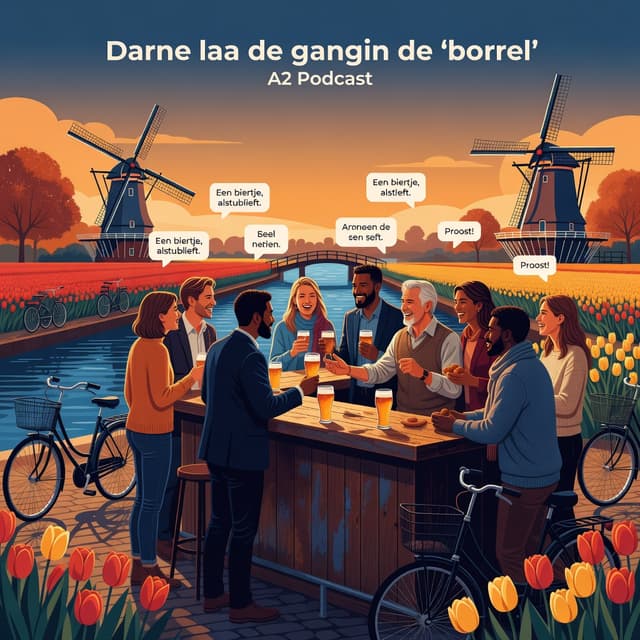
Vandaag nemen we je mee naar dat heerlijke moment waar elke software-ontwikkelaar in Amsterdam naar uitkijkt: de vrijdagmiddagborrel.
Yes, the sacred Dutch after-work drink where office talk melts into gezelligheid and the bier flows faster than the IJ-river.
Picture it: 16.55 uur, you’ve just typed your last semicolon.
Je collega Jeroen slaat zijn handen op de tafel en roept: “Zullen we naar de kroeg?” In Dutch we call this tiny pub around the corner from the office “de kroeg”, spelled k-r-o-e-g.
Repeat after me: kroeg, de kroeg.
Hear that harsh ‘g’?
Make it from the back of your throat, like you’re clearing a path for your stroopwafel.
You walk in, barstool search mode on.
The bartender—de barman—nods.
Time to order.
In episode 28 you mastered coffee, but now we want something stronger.
Say: “Mag ik een biertje, alsjeblieft?” Biertje is the diminutive of bier; the Dutch love making things small and cozy.
If you’re feeling fancy you can ask for een speciaalbiertje, maybe a blondje or een tripeltje.
But watch the alcohol percentage—those speciaalbiertjes can hit like a bike in the fietsfile.
While you wait, let’s squeeze in a grammar snack: word order in sentences with two verbs.
When you say “I want to drink a beer” you place the main verb at the end: Ik wil een biertje drinken.
Subject—time—object—main verb.
Keep that end-verb in your mental backpack; your schoonmoeder will nod approvingly.
Drinks arrive.
Now the toasting ritual.
Lift your glass, make eye contact—super important—and say “Proost!” If you’re with senior colleagues add “Op een goede samenwerking!” meaning “to good collaboration.” Feel free to clink, but gently; Dutch glasses are sturdy but Amsterdam rent is not.
Conversation starter: ask about weekend plans. “Heb je nog iets leuks gepland dit weekend?” Listen for the golden phrase: “Gewoon thuis, beetje bijkomen van de werkweek.” That means “just recovering from the work week.” You can nod wisely and mention your vinyl hunt at the Noordermarkt or the new recipe for stamppot you want to try—bonus cultural points.
Quick pronunciation tip: the combination ‘-cht’ in gewoonLIJK or licht can sound like you’re halfway to clearing your throat.
Practice: licht, nacht, zacht.
Feel the friction in the back, not in English front-of-mouth style.
After two biertjes the group might shift to bitterballen, those deep-fried meaty orbs of happiness.
Order by saying: “Zullen we bitterballen nemen?” They arrive on a little plank, five at a time.
Don’t burn your tongue—steam is hotter than a GPU mining crypto.
Dip in mosterd, bite, smile.
Gezelligheid level unlocked.
Time to leave?
You don’t just ghost.
Say: “Ik ga er even tussenuit, tot maandag!” That means “I’m slipping out, see you Monday.” Pay at the bar: “Mag ik afrekenen?” Pin your card, tap, done.
No tipping stress—round up or add a euro, maar geen big American percentages needed.
Before we wrap: remember the word order rule?
Try making three sentences tonight: Ik wil een stroopwafel eten.
Ik ga morgen fietsen.
Ik probeer Nederlands te spreken.
Put the unconjugated verb at the end and your Dutch colleagues will think you secretly attended a language university.
Laten we samenvatten.
Vandaag leerden we: de kroeg (the pub), de barman (bartender), het biertje (little beer), proost (cheers), speciaalbiertje (craft beer), bitterballen (savory snack), afrekenen (to pay), and tussenuit glippen (slip out).
Grammar focus: two-verb sentence order—remember the main verb at the end.
Volgende keer nemen we je mee naar een echte Dutch dinner party bij je schoonmoeder.
We oefenen complimenten over de kookkunst, overleven awkward vragen over babies, and yes—we’ll teach you how to say “No English please, ik oefen!” See you then, en vergeet niet: oefenen, oefenen, oefenen.
Doei!
Settings
Text
Audio