
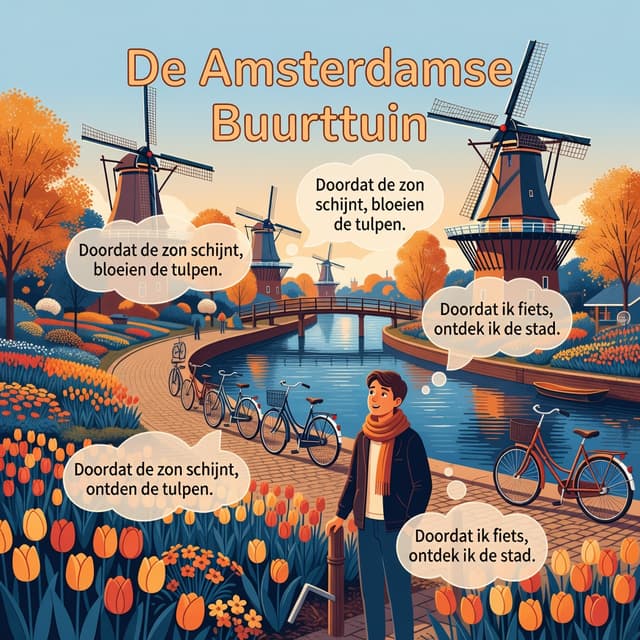
De Amsterdamse Buurttuin en 'Doordat'
Audio1x
Speed
Practice
Woordenschat
Hello.
Goedenavond, ik ben heel goed, dank je wel en jij?
I'm glad you're doing well.
You know, I was thinking about your walk home from work yesterday—you mentioned you pass that little alley near the Albert Cuypmarkt.
Well, I have a secret for you: there's a buurttuin, a community garden, hidden right there.
I stumbled upon it last week, and it's like a tiny green paradise in the middle of the city.
Let me tell you about it.
The garden is called 'De Groene Oase'—the Green Oasis.
It's run by volunteers, and they grow everything from tomatoes to tulips.
I met a woman named Els who has been gardening there for years.
She said, 'Doordat we samenwerken, groeit de tuin elke dag.' That means 'Because we work together, the garden grows every day.' And that's our grammar focus today: 'doordat.'
'Doordat' is used to give a cause that leads to a result.
It's a bit like 'because' but more specific—it always introduces the reason or cause.
For example: 'Doordat het regende, bleven we thuis'—because it rained, we stayed home.
The cause is the rain, the result is staying home.
In Els's sentence, 'samenwerken' (working together) is the cause, and 'de tuin groeit' (the garden grows) is the result.
Now, here are some words from the garden you can use.
First: 'de buurttuin'—the community garden.
You can say, 'Ik loop langs de buurttuin' (I walk past the community garden).
Next: 'de vrijwilliger'—the volunteer.
'De vrijwilligers planten bloemen' (the volunteers plant flowers).
Then: 'de plantenbak'—the planter box.
'In de plantenbak groeien kruiden' (herbs grow in the planter box).
Also: 'het gereedschap'—the tools.
'We delen het gereedschap' (we share the tools).
And: 'de oogst'—the harvest.
'De oogst is groot dit jaar' (the harvest is big this year).
Finally: 'de tuinslang'—the garden hose.
'Doordat de tuinslang lekt, is de tuin nat' (because the garden hose leaks, the garden is wet).
Try making your own sentence with 'doordat' today.
Maybe: 'Doordat ik Nederlands oefen, word ik beter'—because I practice Dutch, I get better.
See?
You're already using it.
So next time you walk past that alley, peek inside.
Maybe you'll see Els or another vrijwilliger.
And if you do, say 'Hallo' and ask about the tuin.
It's a great way to practice your Dutch and meet people.
Tot morgen!
Settings
Text
Audio