
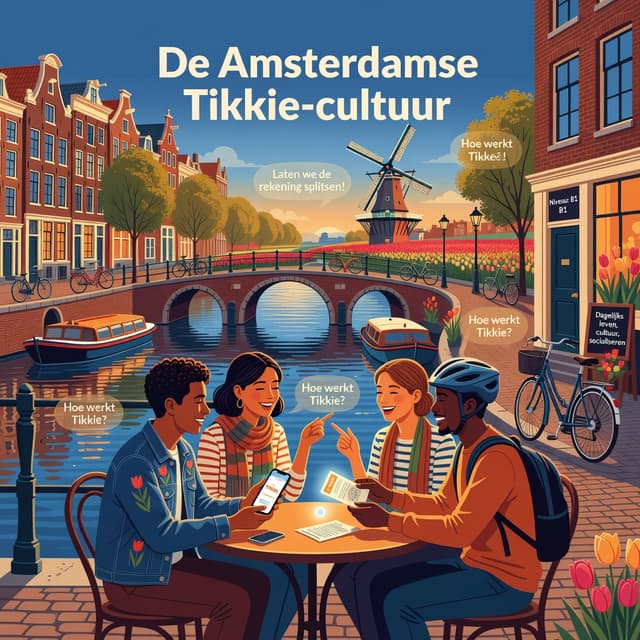
De Amsterdamse Tikkie-cultuur
Audio1x
Speed
Practice
Woordenschat
You told me your big goal is: "Ik hoop dat ik heel goed Nederlands kan spreken." Living in Amsterdam as an international professional, you've probably noticed by now that mastering the language isn't just about surviving at the office; it's about navigating those tricky social moments.
And nothing tests your cultural integration quite like going out for drinks or dinner and dealing with the end of the night.
I'm talking, of course, about the famous Dutch Tikkie culture.
If you've been living in Amsterdam for a while, you've definitely experienced this.
Let's say you are out with your colleagues after work.
You have a few drinks, maybe some snacks.
Then, the waiter brings de rekening, the bill.
In many cultures, someone generously pays for the whole table, assuming someone else will get it next time.
But here in the Netherlands, we generally prefer to splitten.
To split.
We like clarity.
Usually, one person takes charge and says: "Ik zal het wel voorschieten." Voorschieten is a very typical Dutch verb.
It means to advance the money, or to pay upfront for someone else.
So, your colleague pays the whole bill with their pinpas.
But beware, within five minutes of stepping out of the bar, your phone will buzz.
You'll receive a WhatsApp message with a link.
This is het betaalverzoek, the payment request.
Sometimes, internationals are shocked when they open the link and see het bedrag, the exact amount.
It might be something incredibly specific, like €12,85.
Try not to take it personally.
It absolutely doesn't mean your Dutch friends are gierig, which means stingy or cheap.
It's genuinely just the local way of keeping things equal.
Everyone pays for exactly what they consumed.
No more, no less.
To handle this like a true Amsterdammer, let's look at a grammar structure that will make your Dutch sound incredibly natural: using the verb 'zouden' (would) for polite requests.
At a B1 level, you want to move away from direct commands.
Instead of saying "Stuur me een Tikkie" (Send me a Tikkie) or "Ik wil betalen" (I want to pay), you can use 'zouden' to soften your sentence.
If you want to offer to pay upfront, you can say: "Zou ik het voorschieten?" (Should I advance it?).
If someone else paid and you want to prompt them for the request, you ask: "Zou je me een Tikkie kunnen sturen?" (Could you send me a Tikkie?).
Using 'zouden' makes you sound polite, fluent, and perfectly adapted to the local social etiquette.
So, your mission for this week in Amsterdam: when you're grabbing a coffee or a beer with a colleague, offer to pay.
Look them in the eye and say: "Zou ik het voorschieten?
Dan stuur ik je wel een Tikkie." (Should I advance it?
Then I'll send you a Tikkie).
Try it out.
It's a small step, but it's exactly how you reach that goal of speaking Dutch heel goed.
Let me know how they react!
Settings
Text
Audio