
Picture this. You're at a Dutch birthday party. Someone walks in, greets the host with three kisses, then does a slow, deliberate tap on their own temple with one finger while glancing toward the neighbor who parked on the sidewalk again. Nobody says a word. Everybody laughs. And you're standing there with your drink thinking: did I miss something?
You did. And it wasn't a word.
Dutch people are famously direct with language. But there's a whole layer of communication happening in parallel that no textbook ever covers. It's a system of gestures, facial expressions, and physical cues that carry full sentences worth of meaning. Miss them, and you'll understand the Dutch but not really understand the Dutch.
Today we're going to talk about one of the most loaded, most used, most culturally revealing gestures in the Netherlands. The one that replaces an entire editorial.
The Finger-to-Temple Tap (and What It Actually Means)
In many cultures, tapping your index finger to your temple means "smart" or "I'm thinking." In the Netherlands, it almost always means the opposite. One slow, deliberate tap, usually accompanied by a knowing look or a raised eyebrow, means: "That person is not exactly a genius."
More specifically: hij is niet goed bij zijn hoofd (he's not right in the head) or ze is een beetje getikt (she's a little crazy). The gesture wraps that whole judgment into a single motion. No words needed. No drama. Just a tap, a look, and everyone is aligned.

It's deeply economical. Which is very Dutch.
Why This Matters for Your Dutch Learning
Here's the thing most learners don't realize until they've been in the Netherlands for months: Dutch people don't always say the thing. Sometimes they gesture it. Sometimes they imply it. And sometimes the gesture contradicts the words entirely.
You can have a technically fluent conversation in Dutch and still miss 30% of what's being communicated if you're not tuned into the body language channel.
Think about these common Dutch physical cues:
- The slow exhale through the nose with a slight head tilt: "I'm skeptical, but I'll let it go for now."
- The quick double eyebrow raise when you walk into a room: "Hello, I see you, we're good."
- The upward chin lift toward something: "Look at that." or "What about that one?"
- The flat hand wobble (palm down, rocking side to side): "Zo-zo". It's fine. Not great, not terrible. Meh.
- The finger-to-temple tap: You know this one now.

Each of these can replace or reframe a Dutch sentence entirely. They're not rude. They're not unusual. They're just... efficient. And very, very Dutch.
The Cultural Logic Behind It
Dutch directness has a reputation. People talk about it constantly. But what's less discussed is that Dutch directness has a filter. There are things you don't say out loud in polite company, even if you absolutely think them. The gesture is the release valve. It lets you be honest without having to defend yourself in a full conversation.
That finger-to-temple tap at the birthday party? It means everyone is thinking the same thing about the neighbor, nobody wants to spend the whole evening on it, and life moves on. It's social glue wrapped in a single motion.
Compare that to English, where you might whisper to someone, or raise your eyebrows and say "wow" sarcastically, or text someone in the same room. Dutch people just... tap. Done. Next topic.
How to Use This in Your Dutch Practice
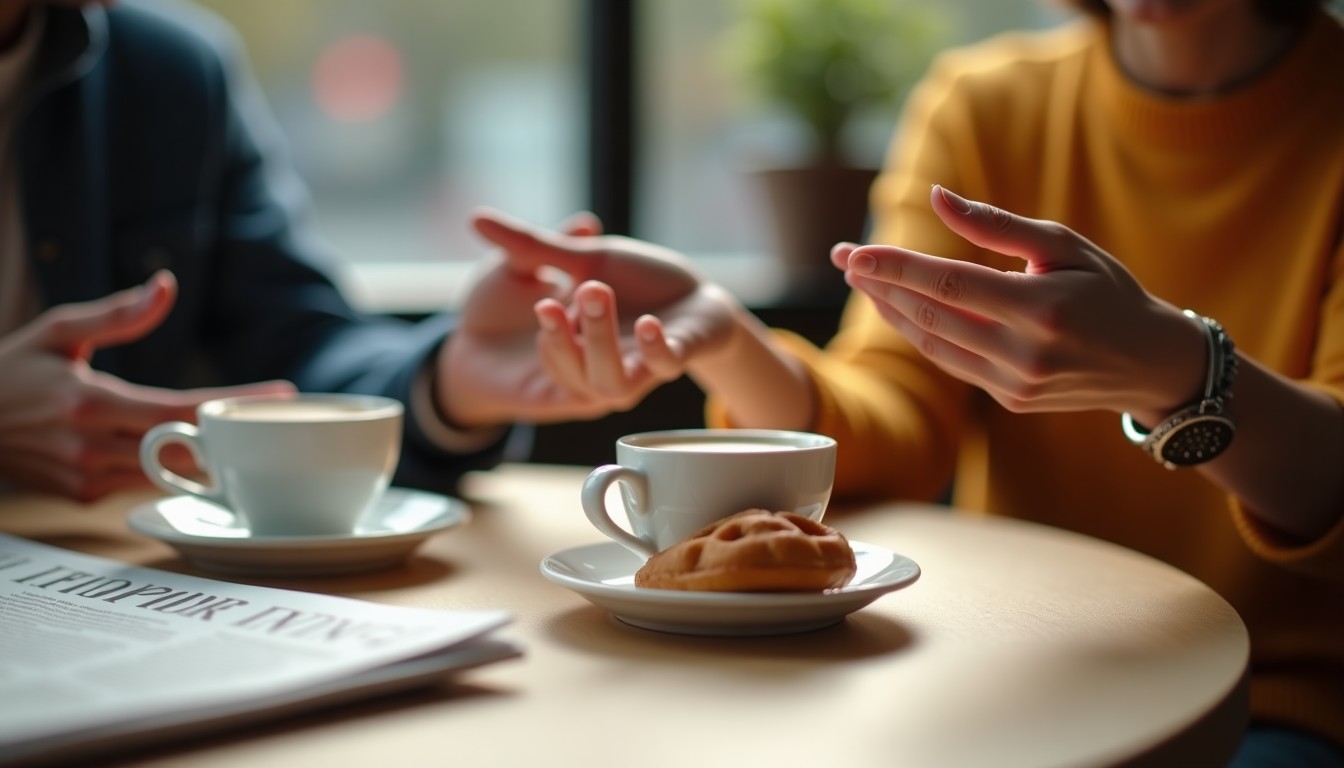
Start noticing. Seriously, this is step one. The next time you watch a Dutch TV show, a vlog, or a conversation at work, put 20% of your attention on the hands, faces, and bodies of the speakers. You'll start seeing a whole second language underneath the words.
Then try mirroring. Not in a creepy way. Just let yourself naturally pick up the flat-hand wobble when someone asks how your Dutch is going. It's the most honest answer anyway.
"Hoe gaat het met je Nederlands?" (How is your Dutch going?)
"Ach, zo-zo." (Ah, so-so.) [flat hand wobble included]
Instant credibility. You'll get a smile every time.
If you want to build the kind of ear and eye that catches these nuances in real speech, the Fluency Tulip uses real Dutch podcast audio so you can hear (and start to see, when paired with video content) how native speakers actually communicate. It's not just about the words. It's about the whole package.
One More Thing: The Gestures Have Regional Flavors Too

Just like Dutch dialects shift when you cross from Amsterdam to Eindhoven to Groningen, the gestures have subtle regional variations. In some parts of the Netherlands, the temple tap is done with the full hand rather than one finger. In others, it's more of a circular motion. Context matters. Company matters.
This is not something to overthink. You're not being graded on your gesture accuracy. But it is something to stay curious about, because the more you notice, the more fluent you actually become. Real fluency isn't just speaking without an accent. It's being in the room and getting it.
And you're getting it. One layer at a time. Goed bezig.
Vocabulary Table
| Dutch | English | Example sentence |
|---|---|---|
| gebaar | gesture | Dat gebaar betekent dat hij het er niet mee eens is. |
| lichaamstaal | body language | Lichaamstaal zegt soms meer dan woorden. |
| niet goed bij zijn hoofd | not right in the head | Die man rijdt door rood; hij is niet goed bij zijn hoofd. |
| getikt | crazy / a bit nuts | Ze is een beetje getikt, maar wel heel grappig. |
| zo-zo | so-so | "Hoe gaat het?" "Zo-zo, het kon beter." |
| wenkbrauw optrekken | to raise an eyebrow | Hij trok zijn wenkbrauw op toen hij het hoorde. |
| efficient | efficient | Nederlanders communiceren graag op een efficiënte manier. |
| impliceren | to imply | Ze impliceerde dat ze het er niet mee eens was. |
| sceptisch | skeptical | Hij keek sceptisch toen ik mijn plan uitlegde. |
| nuance | nuance | De nuance in zijn stem verried dat hij twijfelde. |
| vloeiend | fluent | Ze spreekt vloeiend Nederlands na twee jaar in Amsterdam. |
| spiegelen | to mirror | Kinderen leren door het gedrag van anderen te spiegelen. |