

Audio1x
Speed
Pause
PracticeRead
Mode
Woordenschat
Hello again, and welcome back to Rambl, Dutch for Couples.
I'm Rick.
Today we're going into one of the most Dutch situations you'll ever encounter.
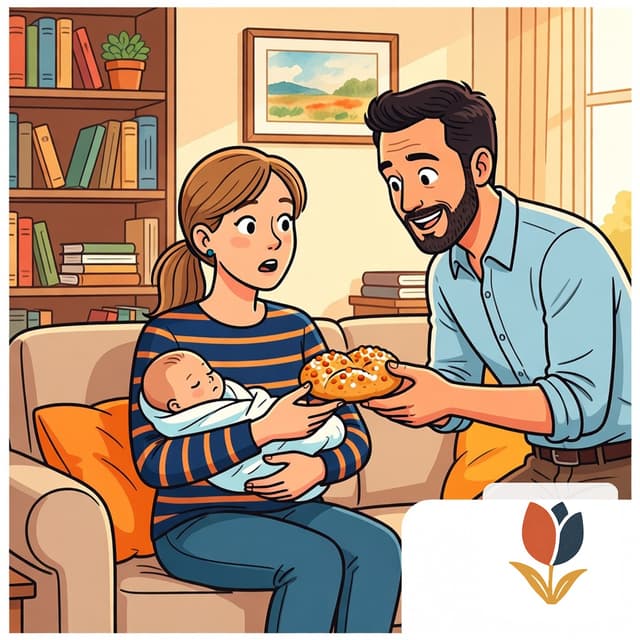
kraamvisite. The baby visit.
Now, if you're from a culture where new babies mean chaos, noise, and everyone passing
the baby around like a parcel, prepare yourself.
Dutch kraamvisites are different.
They're quiet.
They're organised, and they have rules.
You might get a text telling you exactly when to come.
You'll be offered beschuit met muisjes, those rusks with the pink or blue aniseed sprinkles.
The baby will be sleeping, everyone will whisper.
And at some point, someone will ask if you want to hold the baby, and you'll have about
half a second to figure out the right answer.
Sarah's going to visit Thijs' cousin, who's just had her first baby.
Sarah's never done a Dutch kraamvisite before, and she's terrified she'll do something wrong.
Hold the baby too long.
Talk too loud.
Stay too late.
Here's what I want you to listen for.
First, how Sarah complements the baby without going over the top.
Dutch people don't gush.
You're not going to hear, oh my god, she's the most beautiful thing I've ever seen.
You'll hear something much softer, much simpler.
Second, listen to how Sarah handles being offered the baby.
Does she take her?
Does she ask first?
What's the polite move?
And third, notice how she exits.
Kraamvisites are short.
30 minutes, maybe 45.
How does Sarah signal she's leaving without making it awkward?
Right, let's listen.
Sarah, kom binnen, kom binnen.
Zachtjes, hoor, ze slaapt net.
Oh, sorry. Gefeliciteerd!
Hoe gaat het met je?
Moe.
Maar goed, hoor.
Ga zitten, ga zitten.
Wil je koffie?
Of thee?
Koffie is goed, dank je.
Beschuit met muisjes?
Ja, lekker.
Zijn ze... roze?
Ja, een meisje.
Kijk, daar ligt ze.
Oh... wat een lief klein ding.
Ja, he? Ze lijkt op haar vader, vind ik.
Dezelfde neus.
Ja, misschien.
Ze is heel mooi.
Dank je.
Hier, je koffie.
Niet te sterk?
Nee, prima. Hoe was de bevalling?
Lang.
Zeventien uur.
Maar uiteindelijk ging het goed.
Thuis, met de verloskundige.
Thuis?
Wow.
Dat is...
Dapper.
Gewoon normaal, toch?
Waarom naar het ziekenhuis als het niet hoeft?
Ja, ja. Logisch.
En jij?
Wanneer komen jullie aan de beurt?
Oh, eh... we weten het nog niet.
Misschien later.
Ja, dat zeggen ze allemaal.
En dan ineens...
pats,
een baby.
Kijk, ze wordt wakker.
Oh, sorry, praat ik te hard?
Nee, nee, ze moet toch zo eten.
Wil je haar even vasthouden?
Ik... mag ik haar even vasthouden?
Natuurlijk.
Hier,
let op haar hoofdje.
Oh...
hoi.
Hoi, kleine meid.
Ze vindt je aardig,
kijk.
Ze is zo klein.
Hoe... hoe oud is ze nu?
Vier dagen.
Woensdag geboren.
Vier dagen.
Wauw.
Ja. De kraamverzorgster komt nog tot morgen.
Daarna zijn we op onszelf.
De kraamverzorgster helpt veel?
Heel veel.
Ze kookt, ze maakt schoon, ze leert me van alles.
Echt een zegen.
Dat klinkt fijn.
Hm.
Wil je haar teruggeven?
Ik moet haar zo voeden.
Oh, ja, natuurlijk.
Alsjeblieft.
Dank je.
Zo, meisje.
Honger, he?
Ik denk...
ik laat jullie even rusten, ja?
Oh, moet je al weg?
Je bent er net.
Ik wil jullie niet vermoeien.
En ik weet, kraamvisite is kort.
Dat is lief.
Dank je voor je komst, hoor.
Graag gedaan.
Heel veel sterkte, en geniet ervan.
Doe ik.
Groetjes aan Thijs.
Ja.
Dag, dag.
En dag,
kleine meid.
Right.
So that was a kraamvisite.
Let's pull out what Sarah did well.
Because honestly, she nailed most of it.
First, the compliment.
Sarah said,
"Wat een lief klein ding." What a sweet little thing.
Simple, soft, not over the top.
Dutch people don't do superlatives with newborns.
You're not trying to convince the mother that her baby is a supermodel.
You're just acknowledging that yes, this is a nice baby.
"Lief" is your friend here.
Sweet.
Cute.
That's all you need.
Second, the baby holding moment.
This is tricky.
The mother asked,
"Wil je haar even vasthouden?"
Do you want to hold her for a moment?
Sarah didn't just say yes.
She turned it into a polite question herself.
"Mag ik haar even vasthouden?"
May I hold her for a moment?
That little reversal is brilliant.
It shows respect.
It shows you're not assuming.
And it buys you half a second to actually decide if you want to hold a four-day-old baby or not.
Third, the exit.
Sarah said,
"Ik laat jullie even rusten, ja?"
I'll let you rest for a bit, yes?
That "even" is doing a lot of work.
It softens the whole thing.
You're not announcing,
Right, I'm off now.
You're gently suggesting that they probably need space.
And you're offering them that space as a gift.
Kraamvisites are short.
30 to 40 minutes maximum.
You're there to acknowledge the baby.
Eat your beschuit and leave.
Sarah got that.
One last thing.
If you're ever invited to a kraamvisite
and you're not sure what to bring,
don't bring flowers.
Bring something useful.
Fruit.
A meal someone can reheat.
A card with money inside is also completely normal.
The parents are exhausted.
They don't need another vase to wash.
Veel succes met je volgende kraamvisite
en tot de volgende keer.
Settings
Text
Mode
Audio
Pause