

Audio1x
Snelheid
Pauze
OefenenLees
Modus
Woordenschat
Welcome back to Ramble. I'm Rick, and today we are at the deer and arts
praktijk. The vet's surgery. Not the most relaxing place at the best of times, and
certainly not when your cat hasn't eaten in three days and you're trying to follow
a consultation in medical Dutch. This episode is for everyone who has ever sat in a waiting
room, carrier on your lap, cat making that low, unhappy sound, and thought, I cannot do this
in Dutch today. I am too worried. I am too tired. Just speak English to me. I understand
that feeling completely, but here is the thing. The moment you switch to English, you lose
the thread. You walk out not quite sure what the diagnosis was, not quite sure what the
medicine does, and definitely not sure if you're supposed to come back in a week or two.
That uncertainty is worse than the discomfort of struggling in Dutch. So today we listen
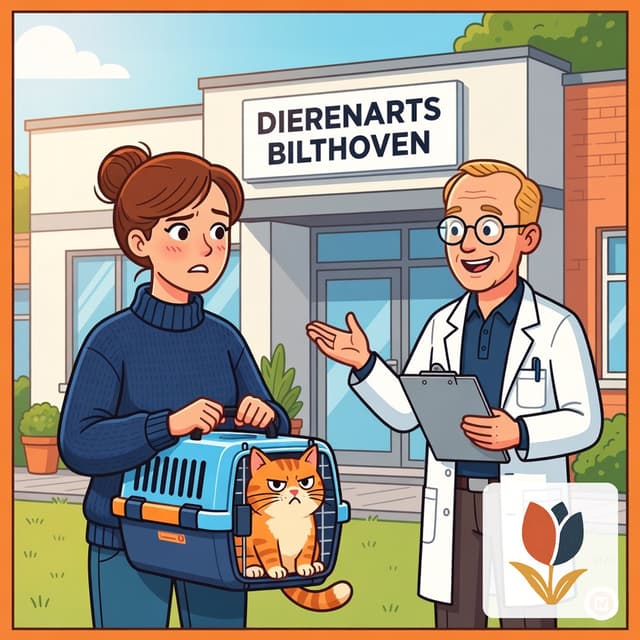
to Sarah. Her cat, Mochi, has stopped eating. She carries the kattendraagmand
into a praktijk in Bilthoven, and she meets a dierenarts who, like many helpful Dutch
professionals, switches to English the moment he senses hesitation. Sarah's job, and yours,
is to hold the conversation in Dutch. Listen out for three things. First, how Sarah asks
the dierenarts to slow down and simplify. She uses the phrase kunt u dat in eenvoudig
Nederlands uitleggen, it is polite, it is direct, and it works every time. Second, how she
repeats key medical terms back to confirm she has understood them correctly. You will hear
her say, blaasontsteking, oké? And that small act of repetition does a lot of work. Third,
how she gently but firmly declines the switch to English. She says, ik snap het wel als
u het rustig zegt, that phrase is worth memorizing before you ever set foot in a praktijk.
Zo, en dit is Mochi. Wat een mooie naam. Hoe oud is ze? Ze is... vijf jaar.
Bijna zes. En ze eet al drie dagen niet. Ik maak me echt zorgen. Dat begrijp ik. Laat me
even kijken. Goed zo, Mochi, rustig maar. Ze reageert een beetje als ik hier druk. Dat is
niet niks. U had al een urine-uitslag meegestuurd via de assistent, toch? Ja, ja. Die kleine...
het bakje. Dat was moeilijk, maar het is gelukt. Ha, goed gedaan. Oké, dus de uitslag laat
een verhoogde concentratie leukocyten zien, en ook wat kristallen in het sediment. Dat wijst
op een ontsteking in de lagere urinewegen. Mogelijk ook een beginnende urolithiasis, maar dat moeten we nog verder
onderzoeken met een echo. Sorry... ik begrijp het niet helemaal. Kunt u dat in eenvoudig
Nederlands uitleggen? Oh, natuurlijk. Ik ga soms te snel. Dus: er zitten witte bloedcellen in haar urine.
Dat betekent dat er ergens ontsteking is. En er zijn kleine kristalletjes gevonden. Die kunnen
pijn geven bij het plassen. Plassen problemen, ja. Ze gaat wel naar de bak, maar... weinig. Exactly, that is a clear sign
of. Sorry, I mean. Shall we continue in English? It might be easier. Nee, dank u. Ik
snap het wel als u het rustig zegt. Oké, prima. Dus: de diagnose is waarschijnlijk een
blaasontsteking. In het Nederlands zeggen we blaasontsteking. Dat is een ontsteking van de blaas.
Blaasontsteking, oké, ik begrijp het. En wat betekent dat voor Mochi?
We gaan haar antibiotica geven. Tien dagen lang, elke dag. En ik wil ook haar
voer aanpassen. Er is speciaal voer voor katten met dit soort problemen. Dat helpt
de kristallen op te lossen. Speciaal voer. Oké. En de echo... moet dat nu?
Niet vandaag. We beginnen eerst met de antibiotica. Als ze na vijf dagen nog steeds niet eet, of
als het erger wordt, dan bel je ons en dan plannen we de echo in. Maar ik verwacht dat
ze al snel weer beter voelt. En hoe geef ik haar de antibiotica? Want
Mochi is... ze is niet makkelijk. Nee, katten zelden wel. We hebben ze in tabletvorm en
in vloeibare vorm. De vloeistof kun je door haar eten mengen. Als ze tenminste iets eet.
Ja, dat is het probleem. Ze eet niets. Dan raad ik de tabletten aan. Je kunt
ze in een klein stukje kip verstoppen. Of we hebben een pillenspuit, als je dat prettiger vindt.
Een pillenspuit? Wat is dat precies? Een klein plastic apparaatje. Hiermee. Je stopt de tablet
erin, en dan duw je hem achter in haar keel. De assistent laat het je zo even zien.
Oh, oké. Dat klinkt een beetje eng, maar... ik ga het proberen. Het gaat echt wel.
En Mochi? Die overleeft het ook wel, hoor. Ja. Ze is sterker dan ze eruitziet. Dank u wel
voor de uitleg. Echt. Geen probleem. We hopen haar snel weer in topvorm te zien.
That was a lot, wasn't it? Medical Dutch, a stressed cat, a well-meaning professional who
immediately reaches for English, Sarah handled every part of it with real composure.
Let me give you your three phrases to take away from today. Number one, kunt u
dat in eenvoudig Nederlands uitleggen? Can you explain that in simple Dutch? This is not rude.
This is not an admission of failure. It is a clear adult request and any good professional
will respect it. Keep it on your phone. Keep it in your head. You will need it one day,
possibly at the worst possible moment. Number two, blaasontsteking, oké, ik begrijp het.
Notice what Sarah does here. She doesn't just nod. She says the word back out loud.
That confirms understanding for both of you. And it means you leave the room with the correct
term in your memory, not a vague impression of something that sounded like a medical word.
Do this with every diagnosis, every medicine name, every instruction. Repeat it back. Number three,
ik snap het wel als u het rustig zegt. I do understand as long as you speak slowly. This phrase does
two things at once. It declines the English offer without being ungrateful. And it gives the other
person a clear instruction for how to help you. Rustig, calmly, slowly. That one word changes the
whole dynamic. Mochi, by the way, is fictional. But the experience is not. Thousands of expat partners
have sat in exactly that consulting room, carrier on the table, vocabulary suddenly blank. You are not alone
and you are more capable than you think. Tot de volgende keer en zorg goed voor je kat.
Aanpassen
Tekst
Modus
Audio
Pauze