
Audio1x
Speed
Pause
PracticeRead
Mode
Woordenschat
Hallo en welkom terug bij My Dutch Adventures!
ENIk ben blij dat je er weer bent.
I'm glad you're back.
ENThis is episode four, and things are getting a little more interesting from here on.
ENSo — you live in Amsterdam.
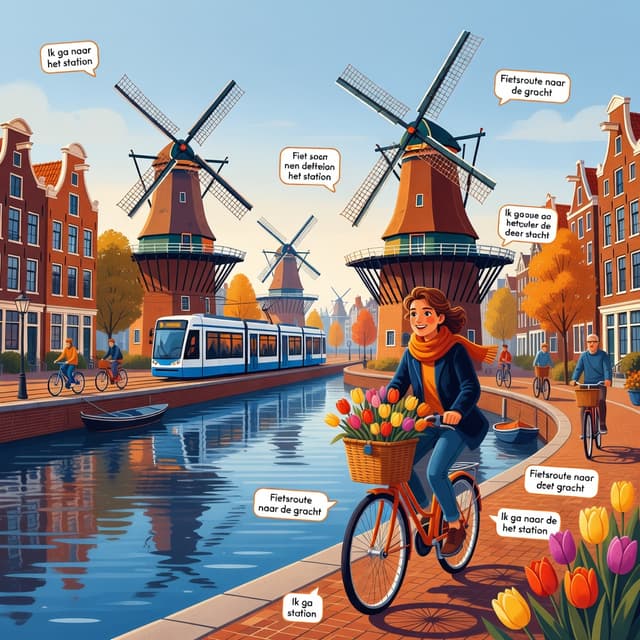
ENAnd if there's one thing Amsterdam is absolutely famous for, besides stroopwafels and canals, it's bikes.
ENFietsen.
Lots and lots of fietsen.
ENYou've probably already dodged a few on the street, right?
ENWell, today we're going to talk about getting around the city — vervoer — which means transport or getting around.
ENLet's start with the most important word in Amsterdam: de fiets.
ENThat's the bike.
ENIf you want to say you're going somewhere by bike, you say: Ik ga met de fiets.
I'm going by bike.
ENPretty straightforward!
And if a colleague asks you tomorrow morning, 'Hoe kom jij naar kantoor?' — how do you get to the office?
EN— you can proudly say: 'Ik kom met de fiets.' I come by bike.
Instant Dutch points.
Now, not every day is a cycling day.
ENAmsterdam has great public transport too.
ENThe tram — de tram — is everywhere.
ENYou might also take de metro or de bus.
And if you're going further, maybe to visit family or travel for work, there's de trein — the train.
ENHere's a really useful phrase: Waar is het station?
ENThat means: Where is the train station?
ENYou'll want that one.
ENAnd if someone gives you directions, they might say: Ga rechtdoor — go straight ahead.
ENOr: Sla rechts af — turn right.
Sla links af — turn left.
These are a bit tricky to remember at first, but you'll hear them a lot.
ENNow let's talk about a grammar concept that trips a lot of people up — and I know word order is something you're working on.
ENIn Dutch, when you start a sentence with something other than the subject — like a time word or a place — the verb and subject flip around.
ENThis is called inversie, or inversion.
ENFor example: 'Ik ga morgen naar kantoor' — I'm going to the office tomorrow.
ENThat's normal order.
ENBut if you start with the time word: 'Morgen ga ik naar kantoor.' See how 'ga' comes before 'ik'?
The verb jumps to the second position.
ENAlways.
This is a really important rule in Dutch, and honestly, once you get used to it, it starts to feel natural.
ENTry it with your commute: 'Elke dag fiets ik naar het werk.' Every day I cycle to work.
ENFiets comes second!
One more fun thing — Amsterdammers love to complain about the weather affecting their commute.
ENVery relatable.
If it's raining — het regent — you might hear people say: 'Ik neem de tram vandaag.' I'm taking the tram today.
ENTotally valid life choice, no judgment.
Alright, let's recap what we covered today.
ENDe fiets — the bike.
Vervoer — transport.
De tram, de metro, de trein — the tram, metro, train.
Rechtdoor — straight ahead.
Sla rechts af — turn right.
Sla links af — turn left.
And het station — the train station.
ENSeven great words and phrases for getting around your city like a local.
ENAnd remember today's grammar: inversion!
ENWhen your sentence starts with anything other than the subject, flip the verb and subject.
ENMorgen ga ik naar het werk.
Practice that one out loud — confidence in speaking comes from repeating things until they feel normal.
ENNext time, we're going to tackle something very important for your social life in Amsterdam — making plans with colleagues and what to say when someone invites you somewhere.
ENHeel erg bedankt voor het luisteren, en tot de volgende keer!
Settings
Text
Mode
Audio
Pause