
Audio1x
Speed
Pause
PracticeRead
Mode
Woordenschat
Hallo en welkom terug bij Dutch Fluency League!
Dit is episode drie van jouw Nederlandse avontuur.
I'm so glad you're back.
ENSo, you've ordered your coffee without switching to English — amazing.
ENYou've talked about your work at the kantoor.
ENNow it's time to tackle something equally important in Dutch life: boodschappen doen.
ENThat means doing your groceries.
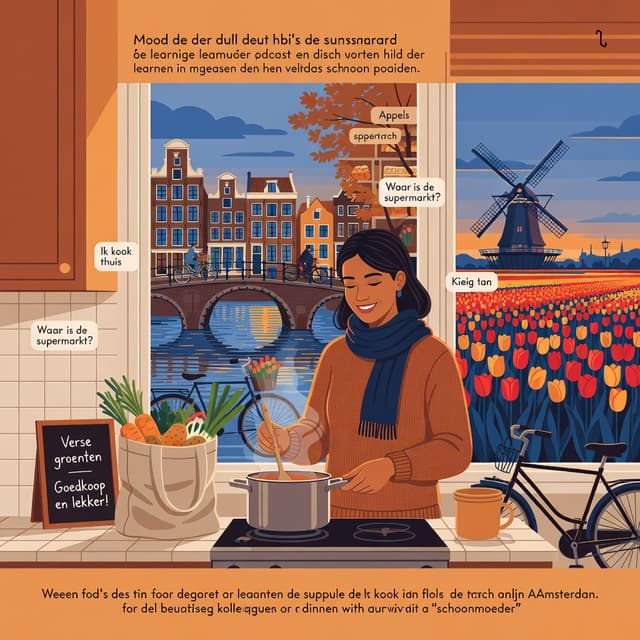
ENIn Amsterdam, you'll find an Albert Heijn on practically every corner, and trust me, knowing a few key words there will make your life so much easier.
ENLet's start with the word supermarkt.
ENYes, you probably guessed that one — supermarkt.
ENIt sounds almost the same as in English.
ENGood news.
Now, when you walk in, you might want to grab a mandje — that's a shopping basket — or a winkelwagen, which is a shopping cart.
ENMandje, winkelwagen.
Say those a few times in your head.
ENNow here's where it gets really useful.
ENYou need to talk about food.
ENThe word for vegetables is groente — groente.
ENAnd fruit is just fruit, same spelling, but we say it a bit differently: froyt.
ENAlmost like you're saying 'fruit' but with a rounder mouth.
ENFroyt.
And if you love cooking, you'll also need kruiden — that means herbs or spices.
ENKruiden.
Okay, let's talk about something close to your heart.
ENStroopwafels.
You already know you're obsessed, and honestly, that is very Dutch of you.
ENIn the supermarkt, you'll find them in the koekjes aisle — koekjes means cookies or biscuits.
ENKoekjes.
Go ahead, treat yourself.
You deserve it.
ENNow, here's today's grammar moment, and this is a big one for you because word order is one of your struggle areas.
ENIn Dutch, when you use a time expression at the beginning of a sentence, the verb and subject flip.
ENThis is called inversion.
ENFor example: 'Ik kook vanavond' means 'I cook tonight.' But if you move the time word to the front, you say 'Vanavond kook ik.' Vanavond kook ik.
ENThe verb kook comes before the subject ik.
ENThis happens a lot in everyday Dutch, so keep an ear out for it.
ENLet's practice.
'Morgen ga ik naar de supermarkt.' Tomorrow I go to the supermarket.
Morgen — tomorrow — comes first, then the verb ga, then ik.
Morgen ga ik naar de supermarkt.
Can you feel how that flows?
ENIt feels a bit backwards at first, but you'll start to hear it everywhere.
ENOne more word before we wrap up: lekker.
ENOh, lekker is such a beautiful Dutch word.
ENIt means delicious, but also nice, or good in general.
EN'Dat is lekker' — that is delicious.
ENYour Dutch colleagues will love you for using this one.
ENAnd your schoonmoeder?
ENIf she cooks for you and you say 'Wat lekker!' — what a result.
ENAlright, let's do a quick recap of today's vocabulary.
ENSupermarkt — supermarket.
Mandje — shopping basket.
Winkelwagen — shopping cart.
Groente — vegetables.
Fruit — fruit, said as froyt.
Kruiden — herbs or spices.
Koekjes — cookies or biscuits.
And lekker — delicious, nice, good.
ENAnd the grammar?
ENInversion.
When a time word like vanavond or morgen starts your sentence, the verb comes before the subject.
ENVanavond kook ik.
Morgen ga ik.
Try using this once today — even just in your head.
ENNext time, we're going to talk about getting around Amsterdam — on your fiets, by tram, and maybe even how to ask for directions without panicking.
ENThat episode is going to be heel handig — very handy.
ENTot de volgende keer!
See you next time!
ENSettings
Text
Mode
Audio
Pause