
Audio1x
Speed
Pause
PracticeRead
Mode
Woordenschat
Hallo en welkom terug bij Dutch Fluency League!
Dit is aflevering vijf — episode five — van jouw Nederlandse avontuur.
Ik ben zo blij dat je er weer bent.
By now you've ordered coffee, talked about work, survived the supermarkt, and even navigated Amsterdam on a fiets.
ENImpressive!
Today we're tackling something you'll definitely need at the office: talking about your free time and making plans.
ENBecause trust me, your Amsterdam colleagues are going to ask.
ENStel je voor — imagine this.
It's maandag, Monday morning.
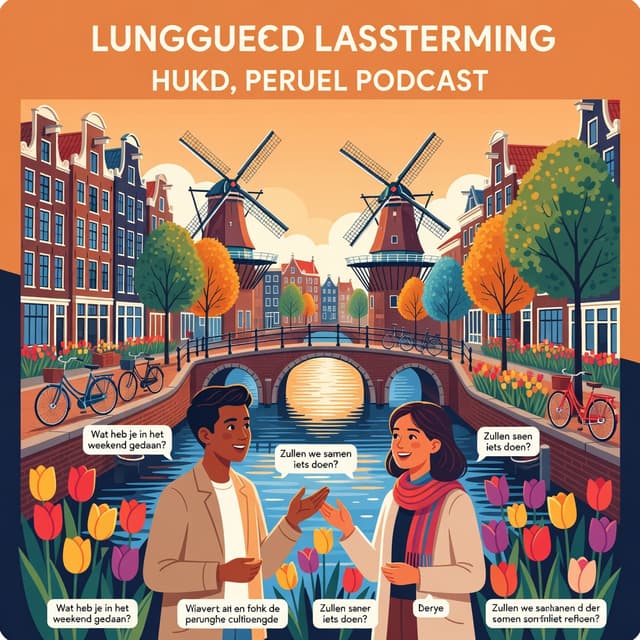
ENYou walk into the kantoor, grab your koffie, and a colleague smiles and says: "Hé, wat heb jij dit weekend gedaan?" What did you do this weekend?
ENThis is your moment.
ENDon't switch to English.
ENYou've got this.
ENLet's build your answer.
ENThe key phrase is: "Ik heb...
gedaan." I did...
ENThis is the Dutch past tense for regular activities, and here's your grammar moment for today.
ENIn Dutch, when you talk about something you did in the past, you use a form of the verb "hebben" — to have — plus a past participle at the END of the sentence.
ENThe verb goes to the end!
ENSo it's not "I listened to music" like in English, but "Ik heb naar muziek geluisterd." Ik heb naar muziek geluisterd.
Notice how "geluisterd" — listened — comes at the very end.
ENThis trips a lot of learners up, but once you feel it, it starts to click.
ENNow let's learn some vocabulary so you can actually fill in that sentence.
ENFirst: vrije tijd.
Dit is jouw vrije tijd — this is your free time.
ENVrije tijd.
Say it with me: vrije tijd.
ENGreat.
Next: muziek.
You already love music and you collect vinyl, so this one's easy.
ENMuziek.
"Ik heb naar muziek geluisterd." I listened to music.
How about: een plaat.
A vinyl record.
ENEen plaat.
Literally it means a plate or disc.
EN"Ik heb een nieuwe plaat gekocht." I bought a new record.
Perfect weekend activity, honestly.
Now: koken.
To cook.
ENYou already know this one a little from episode three, but now we use it in the past: "Ik heb gekookt." I cooked.
ENEasy, right?
Next word: afspreken.
This means to make a plan or to arrange to meet someone.
ENAfspreken.
"Zullen we afspreken?" Shall we make a plan?
ENYou'll use this constantly with colleagues.
ENZullen we afspreken?
ENAnd then: samen.
ENTogether.
Samen.
"Zullen we samen lunchen?" Shall we have lunch together?
ENSuch a simple word, but so warm and useful.
ENOne more: het weekend.
Yes, same as English, but Dutch people use it all the time.
ENHet weekend.
"Dit weekend wil ik fietsen." This weekend I want to cycle.
Which, living in Amsterdam, is very relatable.
ENSo imagine now, back in the kantoor.
ENYour colleague asks: "Wat heb jij dit weekend gedaan?" And you say: "Ik heb thuis gekookt en naar muziek geluisterd.
En jij?" I cooked at home and listened to music.
ENAnd you?
ENYou just had a real Dutch conversation.
ENTulip would be so proud.
Let's do a quick recap of today's vocabulary.
ENVrije tijd — free time.
Muziek — music.
Een plaat — a vinyl record.
Koken — to cook.
ENAfspreken — to make a plan.
ENSamen — together.
Het weekend — the weekend.
And the grammar: in the Dutch past tense, the past participle goes to the END of the sentence.
ENIk heb naar muziek geluisterd.
Keep practicing that word order!
ENVolgende keer — next time — we're going to talk about the weather.
ENI know, I know.
ENBut in the Netherlands, het weer is literally a daily topic.
ENYour schoonmoeder will definitely bring it up.
ENSo tune in, and until then: oefen, oefen, oefen.
ENPractice, practice, practice.
Tot de volgende keer!
Settings
Text
Mode
Audio
Pause